
Real-Time AI Search Visibility Monitoring: A Step-by-Step Setup
Learn how to build a real-time AI search visibility monitoring system across Google AI Overviews, Perplexity, ChatGPT, Reddit, and YouTube. Step-by-step, practical, and compliance-ready.
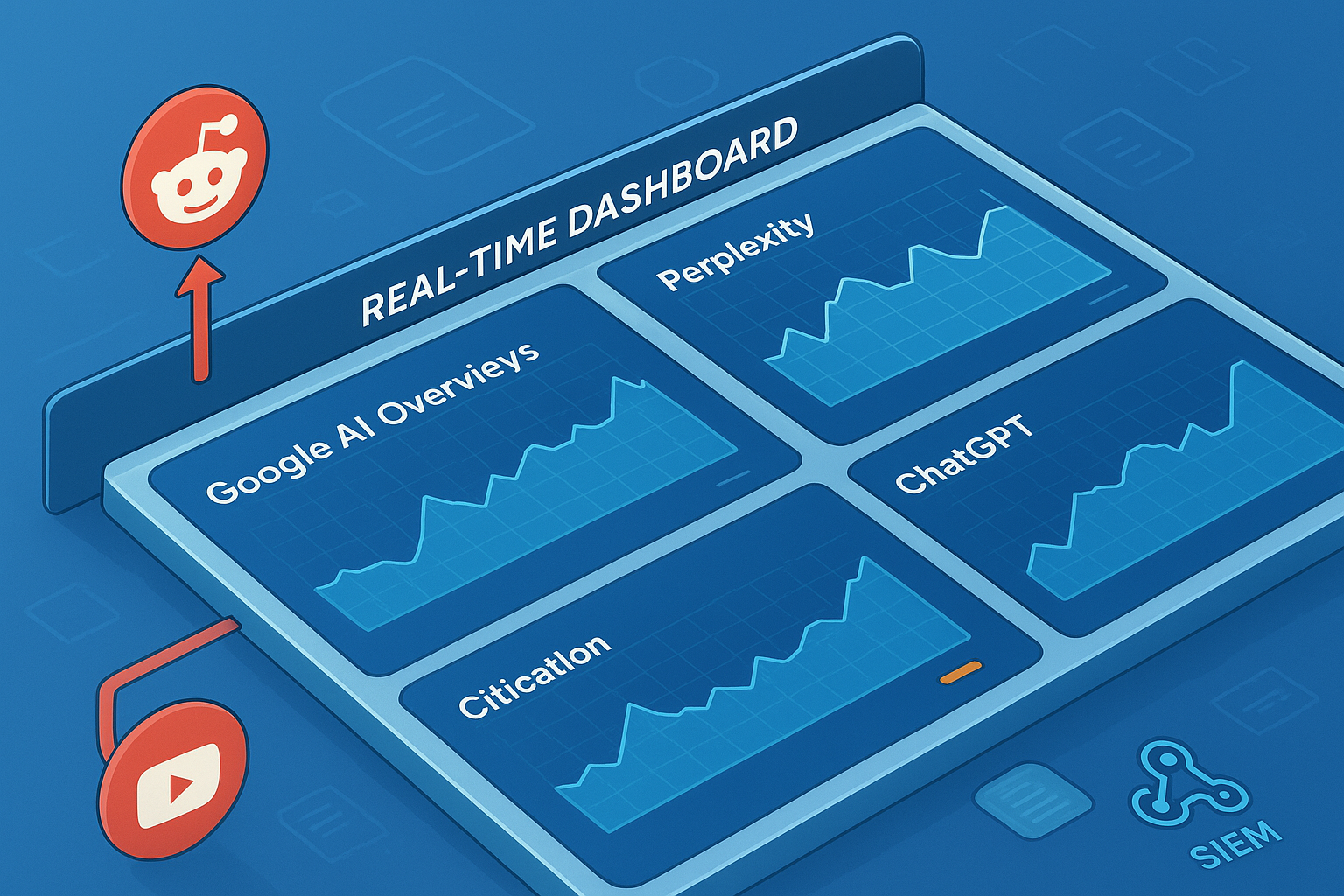
Monitoring how your brand shows up in AI-generated answers isn’t optional anymore. If your visibility drops in Google’s AI Overviews, Perplexity, or ChatGPT responses, the impact can be immediate. This guide walks mid-level SEO/GEO practitioners through a practical, compliant setup for real-time AI search visibility monitoring, anchored on one KPI: share of visibility/voice (SOV). We’ll add upstream Reddit and YouTube signals, competitive benchmarking, alerting pipelines, and BI/SIEM integrations—without scraping the wrong things or tripping ToS.
Step 0 — Define your query set, competitors, and SOV
Start with the measurement foundation.
Query sets: Build stratified sets by intent, category, and locale. Rotate samples to reduce bias.
Competitor cohort: Pick 3–6 realistic peers per category. Avoid “strawman” brands.
SOV definition: SOV_surface = brand_mentions_or_citations / total_mentions_or_citations within the tracked query set. Blend surfaces with weighted aggregation by business priority.
For context on definitions and KPI frameworks, see What Is AI Visibility? and AI Search KPI Frameworks.
Compliance stance: Honor robots.txt/llms.txt guidance; avoid scraping ChatGPT’s web UI; prefer official APIs and reputable SERP APIs for Google’s AI surfaces.
Step 1 — AI search visibility monitoring on Google AI Overviews and AI Mode
Goal: Detect AIO presence and capture cited sources to compute SOV.
Presence detection: Use a SERP API that supports Google AI Overviews and AI Mode. When AIO is present, follow up with the dedicated engine call using a page token to retrieve the full AI Overview content and references.
Citation extraction: Parse referenced sources from returned fields. Store domains, URLs, and positions.
Verification: Confirm presence via multi-run sampling across times and locales; cross-check reference arrays and token stability.
Industry guidance notes that AI Overview availability is volatile by query type and locale. See this overview of measuring AIO presence with SERP APIs and GSC in Search Engine Journal’s 2025 explainer.
Example pseudo-code (Node.js flavor) for AIO follow-up:
const axios = require('axios');
  const serpApiKey = process.env.SERP_API_KEY;

  async function fetchAio(query, gl = 'us', hl = 'en') {
    const base = 'https://serpapi.com/search.json';
    const first = await axios.get(base, { params: { q: query, engine: 'google', gl, hl, api_key: serpApiKey }});
    const pageToken = first.data?.ai_overview?.page_token || first.data?.page_token;
    if (!pageToken) return { presence: false };

    const aio = await axios.get(base, { params: { engine: 'google_ai_overview', page_token: pageToken, api_key: serpApiKey }});
    const refs = aio.data?.ai_overview?.references || [];
    return { presence: true, references: refs };
  }
Pitfalls to avoid:
Treat single-run presence as tentative; confirm across multiple runs.
Respect rate limits and error handling; apply exponential backoff.
Log locale parameters and session assumptions.
Step 2 — Perplexity programmatic tracking
Goal: Retrieve answers and citations where supported, then track deltas.
Setup: Create and manage API keys via Perplexity’s documentation hub. Use the Search API or models that return referenced sources.
Compliance: Follow the Perplexity API Terms of Service 2025 and keep keys secure; avoid submitting sensitive data.
Storage: Persist query, model, parameters, answer, citations, and timestamps.
Skeleton request (Python):
import os, requests
  API_KEY = os.environ['PERPLEXITY_API_KEY']

  payload = {
    "query": "best fintech analytics platforms",
    "search": True,
    "return_citations": True
  }

  resp = requests.post("https://api.perplexity.ai/search", json=payload, headers={"Authorization": f"Bearer {API_KEY}"})
  resp.raise_for_status()
  data = resp.json()
  citations = data.get("citations", [])
For endpoint specifics, start with the Perplexity Search API quickstart.
Step 3 — ChatGPT sampling via OpenAI API
Goal: Sample answer behavior for your queries while acknowledging citation limitations.
Setup: Use the Responses API or Chat Completions with a controlled system prompt and a rotating query set.
Limitation: Standard completions do not provide native citations. If you need sources, pair with a retrieval layer; otherwise, treat these as mention-only samples.
Reproducibility: Log prompts, parameters, models, cadence, and randomized windows.
Example (JavaScript):
import OpenAI from "openai";
  const client = new OpenAI({ apiKey: process.env.OPENAI_API_KEY });

  async function sampleChatGPT(query) {
    const res = await client.responses.create({
      model: "gpt-5.2-mini",
      input: [
        { role: "system", content: "You are a helpful assistant. Keep answers concise." },
        { role: "user", content: query }
      ]
    });
    return res.output_text; // Treat as mention-only; no citations
  }
For expectations and formats, see OpenAI’s latest model guidance and deep research notes in the official docs.
Step 4 — Upstream signals from YouTube
Goal: Detect emerging topics and creators that may influence citations.
Polling: Use the YouTube Data API search endpoint with q and type=video; add publishedAfter for incremental runs.
Captions: Check captions availability; download only when authorized.
Quotas: Respect quotas and optimize calls.
Reference: YouTube Data API videos list.
Example (Python):
import requests, os
  API_KEY = os.environ['YOUTUBE_API_KEY']

  search = requests.get("https://www.googleapis.com/youtube/v3/search", params={
    "part": "snippet",
    "q": "fintech analytics",
    "type": "video",
    "publishedAfter": "2026-01-01T00:00:00Z",
    "key": API_KEY
  })
  items = search.json().get("items", [])
  video_ids = [i["id"]["videoId"] for i in items]
Step 5 — Upstream signals from Reddit
Goal: Spot trending discussions and sources that can prefigure AI citations.
OAuth: Register your app and use OAuth via Reddit’s app portal.
User-Agent and rate limits: Reddit’s Data API Wiki outlines rate limits and headers. Never misrepresent your UA.
Polling cadence: Query /r/{subreddit}/new with after/before; backoff on 429 using Retry-After.
Mapping: When a subreddit thread or YouTube creator starts dominating your category, prioritize related queries in AI monitoring for the next polling window. Think of upstream signals as weather radar for your citations. Make sense?
Step 6 — Storage schema and computing SOV
Design a time-series schema that supports per-surface analysis and blended views.
Core fields: surface, query_id, locale, timestamp, presence, answer_text_hash, citations array with domain, url, position, competitor flags, model/endpoint params, confidence.
SOV calculation: For each surface and time bucket, compute brand_cited / total_citations across the query set; also compute blended SOV with weights.
Volatility index: Track AIO presence rate per query set and locale; flag sudden changes.
Mini-example (SQL-ish):
-- Count citations for a brand per surface per day
  SELECT surface, date_trunc('day', timestamp) AS day,
         SUM(CASE WHEN citations @> ARRAY['yourbrand.com'] THEN 1 ELSE 0 END) AS brand_mentions,
         COUNT(*) AS total_mentions,
         SUM(CASE WHEN citations @> ARRAY['yourbrand.com'] THEN 1 ELSE 0 END)::float / COUNT(*) AS sov
  FROM ai_visibility_events
  WHERE locale = 'en-US'
  GROUP BY 1, 2;
Step 7 — Thresholds, anomaly detection, and alerts
Goal: Notify stakeholders only when it matters.
Baselines: Use rolling 7–14 day baselines and week-over-week deltas.
Thresholds: Trigger alerts when SOV drops by a defined percentage or when high-value citation domains disappear.
Deduplication and hysteresis: Prevent alert storms by requiring sustained change for N polling intervals.
Webhook security: Validate signatures, respond quickly, and process asynchronously per GitHub’s webhook guidance; Stripe documents retry windows and delivery behavior.
Sample alert payload:
{
    "surface": "google_ai_overview",
    "query_set": "fintech_analytics_en_US",
    "sov_delta": -0.18,
    "confidence": 0.74,
    "lost_domains": ["example-highvalue.com"],
    "window": "2026-01-06T10:00Z/2026-01-06T10:15Z"
  }
Step 8 — Dashboarding and competitive benchmarking
Goal: Visualize SOV by surface, track competitors, and share executive summaries.
Views: Per-surface SOV, blended SOV, citation domain distribution, competitor deltas, and volatility indices.
Benchmarking: Normalize by category; compare peer performance across the same query set.
Destinations: BI tools or SIEM for auditability and incident workflows.
Disclosure: Geneo is our product. A consolidated dashboard like Geneo can be used to ingest outputs from the pipelines above to assemble cross-engine visibility views and competitive reports.
Troubleshooting quick reference
Symptom | Likely cause | Fix |
|---|---|---|
AIO present intermittently | Volatile rollout experiments | Multi-run confirmation; stagger polling; log gl hl |
Missing citations in Perplexity | Endpoint model selection | Use Search API or models that return references; check docs |
No citations in ChatGPT | API limitation | Treat as mention-only or add retrieval layer |
Reddit 429 errors | Rate limit exceeded | Respect headers; exponential backoff; descriptive User-Agent |
YouTube quota warnings | Over-polling | Narrow keywords; use publishedAfter; cache videoIds |
Alert storms | Threshold too tight | Add hysteresis; dedup similar events; raise minimum delta |
Verification checklist
SOV anchored and query sets stratified by intent and locale.
Google AIO AI Mode parsing tested with multi-run confirmation.
Perplexity citations stored; deltas validated.
ChatGPT sampling logged and treated as mention-only.
YouTube and Reddit polling cadence compliant; headers and quotas respected.
Alert pipeline uses signed webhooks with retries and idempotency.
Dashboards show per-surface and blended SOV with competitor benchmarking.
Next steps
Backtest thresholds on historical data, then go live with a 5–15 minute polling cadence.
Establish weekly executive rollups and an incident playbook for visibility drops.
Prefer a ready-made cross-engine dashboard? Consider integrating the outputs with Geneo to streamline reporting and benchmarking.