
12 Essential AI Search Ranking Factors for 2025 Revealed
Discover 12 proven AI ranking factors for Google, ChatGPT, Perplexity & Bing. Boost your brand’s AI visibility in 2025. See what drives citations—act now!
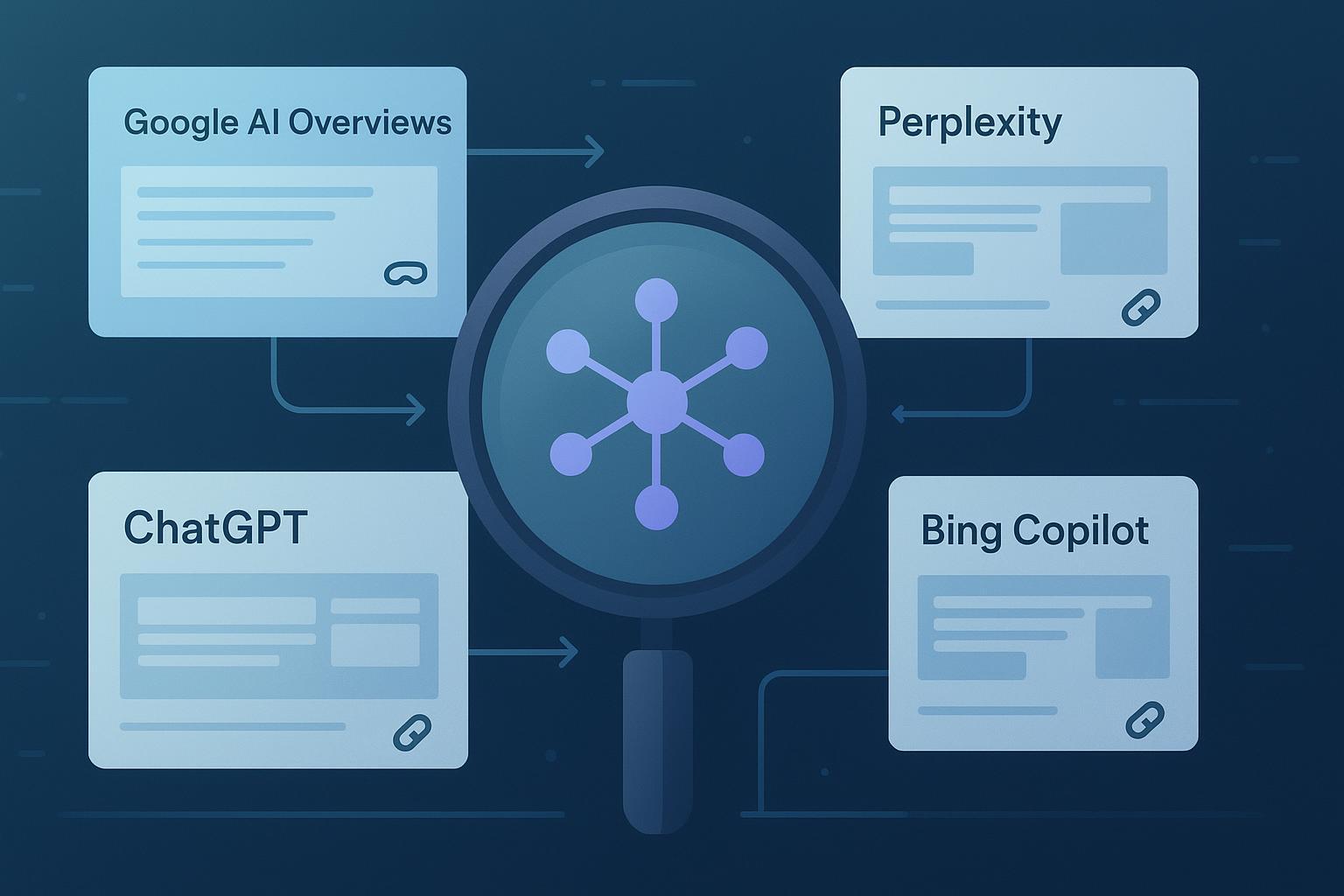
If your brand isn’t appearing inside AI answers, you’re invisible where decisions increasingly happen. This 2025 analysis reveals how leading AI answer engines—Google AI Overviews, Perplexity, ChatGPT Search, and Bing Copilot—select and rank sources, what signals they favor, and how marketers can earn citations ethically.
We’ll stick to evidenced behaviors, cite official docs and credible studies, and flag observational patterns where hard documentation is limited.
Google AI Overviews: authority, freshness, and passage‑level relevance
Google describes AI Overviews as snapshots “grounded” in web sources from its index. The May 2025 guidance for site owners highlights helpful, trustworthy content and clear expert signals for eligibility in AI features. See Google’s own explanations in AI features and your website and the May 21, 2025 Search Central post Top ways to ensure content performs well in AI Search.
What rises to the top?
- Authority and E‑E‑A‑T alignment: Pages demonstrating expertise and trustworthy sourcing are consistently favored.
- Freshness: Statistics and facts need to be current, especially for time‑sensitive queries.
- Passage‑level relevance with organic overlap: Independent studies show substantial overlap between AIO citations and organic rankings, suggesting passage selection from authoritative pages with additional corroboration and diversity. For example, Search Engine Journal reported a 54% overlap between AIO citations and organic results (2024 dataset), and SE Ranking’s recap showed 61.9% of AIO citations came from the top 100 results (Nov 2024).
- Diversity/corroboration: AIO aims to give exploration pathways rather than a single canonical source; Google’s product post explains how links support verification in Generative AI in Search.
Prevalence and volatility matter. AIO trigger rates have swung over the past year, with third‑party trackers noting surges and pullbacks depending on query types and ongoing updates, as summarized by Search Engine Land’s 2025 surge/pullback coverage.
Watchouts: Google’s March 2024 core update and spam policies target scaled low‑value content and site‑reputation abuse, which can reduce inclusion in AI Overviews. Review the official March 2024 core update and spam changes and site reputation abuse policy.
Practical tip: Align with Google’s expectations—clear expert signals, consistent entities, structured data, updated facts—and monitor your AIO visibility trends regularly.
Perplexity: trustworthy structure, recency, and multi‑source reasoning
Perplexity is a real‑time answer engine with transparent citations and multi‑step retrieval. Official docs describe Pro Search (tools that fetch and read web content) and Deep Research (iterative browsing across many sources). See Pro Search quickstart and Introducing Deep Research.
What gets cited?
- Authority and clarity: Guides and credible analyses emphasize clearly structured, trustworthy sources with unambiguous headings, FAQs, and data tables. Perplexity’s product materials and optimization guides reflect this emphasis, e.g., Perplexity’s prompt guide and third‑party overviews like Semrush’s Perplexity optimization tips (2025).
- Freshness: Recency bias appears for current topics; recent updates improve citation likelihood.
- Focus and diversity: Focus modes (e.g., academic or social) and the system’s preference for diverse corroboration shape the mix of sources. Enterprise features like Internal Knowledge Search add non‑web sources; see Internal Knowledge Search.
Constraints: Robots.txt rules, paywalls, and partial fetches can affect what Perplexity can read fully. Behavior varies by site; verify on a per‑domain basis.
Practical tip: Publish clear, indexable content with concise summaries, FAQs, and well‑labeled data. Ensure recent updates are visible and that pages load quickly for fetch tools.
ChatGPT Search: browsing triggers, source diversity, and plan‑gated depth
OpenAI’s 2024–2025 updates make web search broadly available while continuing to refine accuracy and link presentation. The official announcement Introducing ChatGPT search and the running ChatGPT release notes outline improvements and availability.
What influences inclusion?
- Browsing triggers: For timely or unfamiliar topics, ChatGPT initiates web searches and selects relevant sources during reasoning.
- Source diversity and trust: Presentation favors a mix of reputable domains, with links shown in responses; transparency of all browsing steps has varied in 2025. For brand‑mention behavior and optimization context, see Why ChatGPT Mentions Certain Brands.
- Plan constraints: Some deep‑research behaviors are gated by plan and feature access; see ChatGPT pricing and plans.
Constraints: Policy limits reduce reliance on unverifiable or behind‑paywall content. The UI may browse differently than the API, and the visibility of browsing logs has changed over time.
Practical tip: Provide authoritative, clearly structured pages with up‑to‑date data and easy verification. Expect variability in how citations appear and be ready to track mentions over time.
Bing Copilot: grounding, provenance checks, safety filters, and localization
Microsoft documents that Copilot is grounded in Bing Search. Prompts are transformed into secure queries, relevant results are retrieved, and provenance/semantic checks determine the citations shown. Review Web search access and citations in Microsoft 365 Copilot Chat and Understanding web search in Copilot Chat.
What matters?
- Provenance and authority: Copilot validates passages and prefers reputable sites; safety layers filter risky content. See Copilot privacy and protections in Microsoft’s Copilot privacy guidance, and the broader safety posture documented in Bing’s Systemic Risk Assessment (Aug 2024).
- Localization and personalization: Conversation context, locale, and time can influence retrieval; enterprise controls govern exposure and web access.
Practical tip: Optimize passages for clarity and authority, ensure content complies with safety filters, and reflect local cues (language/region) where relevant.
Cross‑engine signals and constraints
Below is a quick comparison of common signals, typical constraints, and practical notes.
| Engine | Evidenced signals | Constraints/filters | Practical notes |
|---|---|---|---|
| Google AI Overviews | E‑E‑A‑T, freshness, passage relevance, diversity | Core/spam updates; site reputation abuse guardrails | Demonstrate expertise, update facts, use schema, ensure entity consistency; monitor AIO visibility |
| Perplexity | Authority/clarity, recency, focus modes, multi‑source reasoning | Robots/paywalls; enterprise internal sources | Publish clear FAQs, datasets, summaries; keep content fast and indexable; track citations |
| ChatGPT Search | Timely queries trigger browsing; links to sources; plan‑gated depth | Policy limits; variable browsing transparency | Provide authoritative, structured content; expect variable citation display; monitor mentions |
| Bing Copilot | Provenance checks, semantic grounding, citations | Safety filters; SafeSearch; web blocking | Optimize passages; ensure safe, authoritative content; reflect localization cues |
Negative and volatile factors to watch
- Spam and low‑value content, scaled/templated pages, or site‑reputation abuse can reduce visibility in AI Overviews, per Google’s updates and policies: March 2024 core update and spam changes and site reputation abuse policy.
- Safety and moderation filters suppress harmful or low‑integrity content in Copilot: see Copilot privacy and protections and Bing’s Systemic Risk Assessment (Aug 2024).
- Access constraints (robots.txt, paywalls, login/noindex) can block full reading/fetching: see AI features and your website and Perplexity Pro Search quickstart.
- Contradictions and unverifiable claims reduce citation likelihood across engines; corroboration is favored. Google reiterates this in Top ways to ensure content performs well in AI Search.
How to optimize and measure today
First, define what “AI visibility” means for your team and how you’ll measure progress. For foundations, see What Is AI Visibility? Brand Exposure in AI Search Explained and KPI guidance in LLMO Metrics: Measure Accuracy, Relevance, Personalization.
Action plan:
- Publish expert, verifiable pages with updated facts and clear structure (FAQs, summaries, tables). Use schema where applicable and align entities consistently.
- Refresh recency signals on time‑sensitive topics; annotate updates.
- Consider team branding and author credibility in profiles; for playbooks, see LinkedIn Team Branding for AI Search Visibility: 2025 Best Practices.
- Track inclusion inside AI answers, not just classic SERPs. Disclosure: Geneo is our product. It monitors visibility, citations, and sentiment across ChatGPT, Perplexity, and Google AI Overviews—helpful for reporting and finding optimization opportunities.
Prefer alternatives or want broader benchmarking? Consider tools like TryProfound (citation pattern analytics across AI platforms) or RankShift (focused Perplexity visibility tracking). Agencies can explore multi‑brand reporting workflows on Geneo’s agency page.
Soft CTA: If you’re testing GEO/AEO initiatives, a lightweight monitor helps you catch inclusion changes quickly. Geneo offers multi‑team support and free trials; use whatever tracker fits your stack, but do measure consistently.
The bottom line
AI engines reward authoritative, fresh, clearly structured content they can corroborate and safely ground. Exact weights are proprietary, but you can influence inclusion with expert signals, up‑to‑date facts, clean schemas, and consistent entities. Will every query show an AI answer? No. But when it does, being in the citation set is the difference between being considered and being ignored.
Here’s the deal: treat AI visibility as a real performance channel. Ship improvements weekly, watch the volatility, and iterate based on what shows up inside answers—not just rankings. Then report it, learn, and keep going.