
AI Search Instability Monitoring for Health (YMYL)
Best-practice guide to AI search instability monitoring for health informational (YMYL) queries — benchmarks, EWMA/z-score alerts, and triage workflows for SEO and compliance teams.
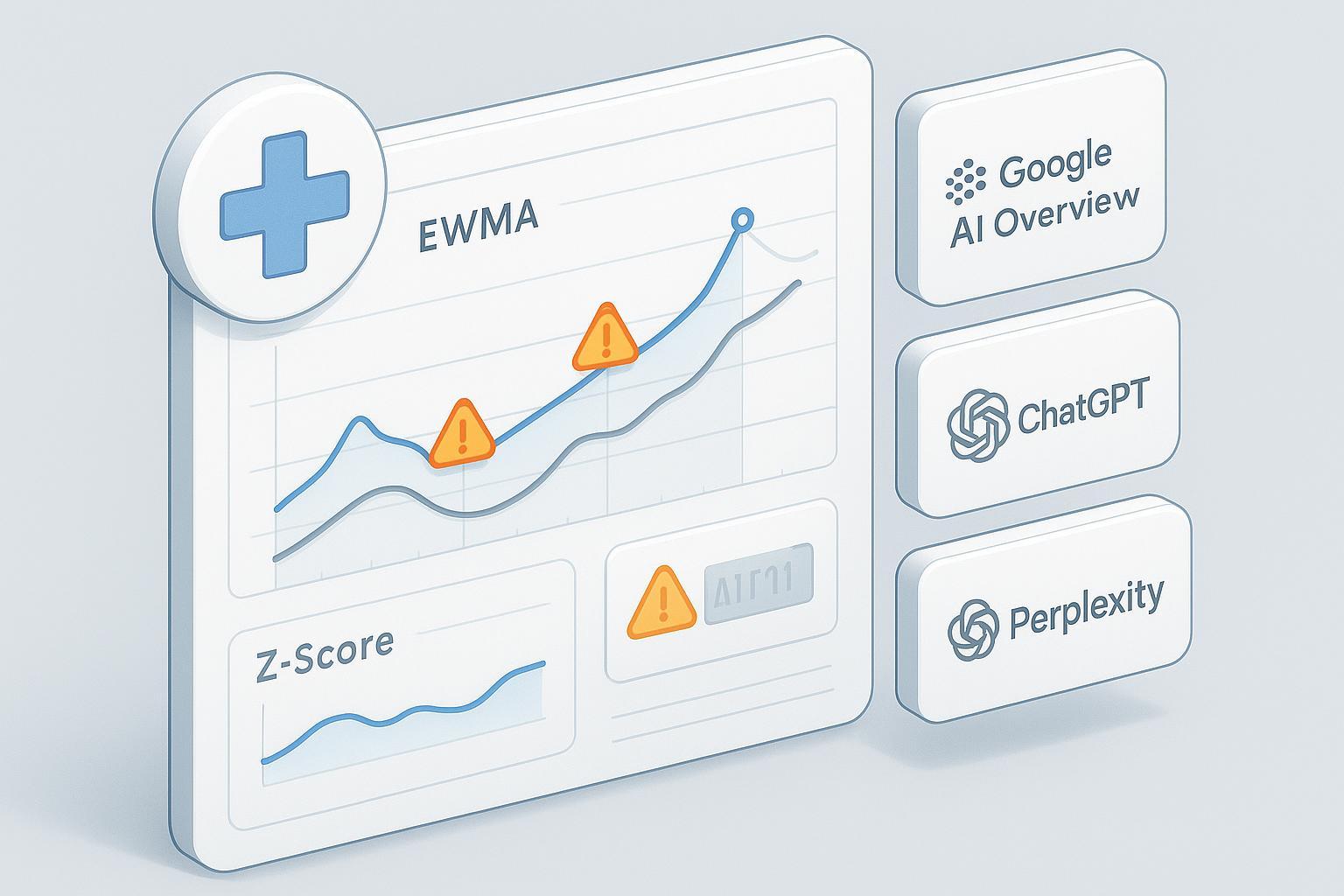
When health answers wobble, trust and outcomes wobble with them. This guide shows how to measure and act on AI search instability by category or query type—anchored in Health × Informational (YMYL)—so your team can catch risky drifts early, reduce noise, and document every fix. Practically speaking, AI search instability monitoring helps you distinguish harmless variance from dangerous shifts that warrant SME review and remediation.
What instability means in AI answers and why health YMYL demands caution
Instability spans several patterns you should track across AI Overviews and answer engines:
Semantic drift: the answer’s claim subtly shifts from accepted guidance.
Hallucination: unsupported or incorrect statements.
Citation loss or quality decay: authoritative sources vanish or get replaced by lower‑quality domains.
Visibility volatility: brand/domain mentions and citation share change substantially.
Health topics are high‑stakes. Stronger E‑E‑A‑T signals and transparent sourcing are non‑negotiable, and human review gates are essential. Google’s guidance emphasizes people‑first content, reputable citations, and consistency across structured data and on‑page signals; these are foundational for AI search as well. See Google’s advice in the Search Central blog on succeeding in AI Search and related policy updates for quality alignment: Top ways to ensure content performs well in AI Search (2025) and March 2024 core update and spam policies.
Metrics and conservative benchmarks for Health × Informational
Not all variance is harmful. Your goal is to separate normal fluctuations from abnormal, YMYL‑risk changes—core to any AI search instability monitoring program.
Factuality/hallucination proxy: Track claim‑level support (FactScore‑style audits). Aim for <5% unsupported claims in weekly samples; alert at ≥10%. See long‑form factuality research outlining FactScore methodologies (arXiv 2024–2025).
Semantic similarity: Measure cosine similarity between current answers and vetted references. Alert on sustained drops beyond 2 standard deviations from a 28‑day baseline.
Citation presence and quality: Monitor citations per answer and the proportion from NIH/CDC/PubMed. Alert if citation presence declines >15% week‑over‑week or |z| ≥ 2.
AI visibility share (SOV): Baseline a 28‑day rolling mean of your domain’s mentions/citations per engine. Alert when week‑over‑week change >15% or |z| ≥ 2.
URL stability in AI Overviews: Semrush reported high AIO URL volatility with averages of ~12 changes per keyword over 31 days and ~4‑day stability windows (general cohort). Treat rapid churn in health queries as a risk signal; tighten alert bands accordingly. Source: Semrush’s URL volatility in AI Overviews (2024).
Coverage/appearance context: BrightEdge observed high AIO appearance for healthcare queries, justifying daily sampling. See Search Engine Land’s coverage summarizing industry data: AIO visibility and appearance trends in healthcare.
Below is a benchmark summary to start with—validate locally before enforcing:
Metric | Baseline method | Warning threshold | Critical threshold | Recommended action |
|---|---|---|---|---|
Citation presence (%) | 28‑day mean (μ), SD (σ), EWMA smoothing | WoW drop >15% or | z | ≥ 2 |
Visibility share (SOV) | 28‑day μ, σ per engine/category | z | ≥ 2 | |
Hallucination proxy (%) | Weekly human audit n≥30 | ≥5% unsupported claims | ≥10% unsupported claims | Immediate SME gate; fix claims and references |
URL stability (days) | 31‑day tracking of cited URLs | <5 days (avg) | <3 days (avg) | Prioritize NIH/CDC/PubMed; strengthen schema and internal links |
For source transparency on metrics and context, see: Search Engine Land’s AI visibility playbook and Conductor’s AEO/GEO benchmarks. For factuality proxies, consult long‑form FactScore methodology overviews (arXiv 2024–2025).
Best-practice AI search instability monitoring workflow (people, process, cadence)
A reliable program balances automation with human oversight.
Data ingestion: Orchestrate daily prompts across engines (Google AI Overview, ChatGPT, Perplexity, Gemini, Claude). Capture full answer text, citations, and metadata (timestamp, engine, query variant).
Segmentation: Maintain stratified sets by intent × category (Health × Informational subtopics like conditions, nutrition, treatments). Keep n≥30 per segment for stable σ.
Baselines: Compute 28‑day rolling μ and σ per metric per engine. Apply EWMA smoothing (α ≈ 0.25) to control noise.
Alerting: Use z‑score and EWMA residual rules with severity tiers; route informational alerts to Slack, warnings to business‑hours paging, critical to immediate paging plus SME review.
Triage: Verify answers and citations quickly; classify risk; document actions and rationale.
Remediation: Update or enrich content, elevate authoritative sources, tighten schema/RAG retrieval, and throttle risky query variants if needed.
Postmortem: Record root cause, timeline, metrics deltas, and lessons; recalibrate baselines monthly.
Role matrix and cadence suggestions:
SEO/GEO lead: owns segmentation, baselines, alert rules.
Medical SME: validates health claims; approves remediation.
Content lead: implements updates and schema enhancements.
ML/Ops engineer: manages orchestration scripts and alert integrations; runs canary experiments.
Comms/PR: handles external messaging if misinformation spreads.
Cadence: daily automated sampling; weekly human audits (n=30–50); monthly baseline recalibration and governance review. For governance guidance, see Lumenova’s monitoring best practices and NIST’s AI Risk Management Framework.
Alert rules you can copy today: z‑score and EWMA for AI search instability monitoring
Z‑score anomaly detection: z = (x − μ) / σ over a rolling 28‑day window. Trigger warning at |z| ≥ 2; critical at |z| ≥ 3.
EWMA smoothing: S_t = α·x_t + (1 − α)·S_{t−1}, with α ≈ 0.25 for daily health informational sets. Alert on residuals exceeding confidence bands.
Worked example (Visibility share):
Compute μ and σ for the last 28 days of SOV in Perplexity for “nutrition facts” queries.
Today’s SOV drops from 22% to 15%. z = (15 − μ) / σ. If |z| = 2.3 (warning), open triage; if a second day pushes |z| ≥ 3 or WoW drop ≥25%, escalate to critical.
Apply EWMA with α=0.25 to reduce false positives; trigger when the EWMA residual breaches your band.
For practical anomaly guidance, review Datadog’s anomaly detection primers and PagerDuty’s incident response playbooks.
Health × Informational walkthrough: from alert to resolution
Baseline: You track “vitamin D dosage,” “symptom overview,” and “treatment vs. risks” queries daily. Citation presence and quality (NIH/CDC/PubMed) sit within normal bands.
Alert: Citation presence drops 18% week‑over‑week for “vitamin D dosage” answers, EWMA residual exceeds your threshold, and |z| = 2.4.
Triage: A medical SME checks the answer and finds an authoritative NIH link replaced by a lower‑quality blog. Risk: medium (informational drift).
Remediation: Update the related content with peer‑reviewed references, strengthen schema and internal links, and adjust retrieval/prompting to prefer PubMed/NIH sources.
Stabilization: Within a week, citations from authoritative domains return; visibility share returns within ±1 SD of baseline. Postmortem documents steps and refines alert bands. This end‑to‑end example shows why disciplined AI search instability monitoring matters in health.
Supporting context: Semrush’s AIO URL volatility underscores why citation churn matters; Search Engine Land’s visibility guidance provides KPI framing.
Practical example: using a visibility platform to set baselines (Geneo micro‑example)
Disclosure: Geneo is our product.
A visibility platform can track cross‑engine brand mentions and citations and compute a visibility score per category. In Geneo, you would segment Health × Informational queries (e.g., “vitamin D dosage,” “hypertension symptoms”) and establish a 28‑day baseline for citation presence and visibility share across ChatGPT, Perplexity, and Google AI Overview. Configure EWMA smoothing (α≈0.25) and z‑score alerts (warning at |z|≥2, critical at |z|≥3). When an alert fires, route a Slack message to the SEO/GEO lead and the medical SME. For a platform overview, see AI visibility monitoring across ChatGPT, Perplexity, and Google AI Overview.
Checklists and templates
Triage checklist (YMYL health):
Verify the answer’s core claims against reputable sources (NIH/CDC/PubMed).
Confirm citation presence and domain quality; note any churn.
Assess user impact and risk level; decide on temporary flags.
Draft remediation steps (content updates, schema, retrieval preferences).
Document decisions, actions, and owners; schedule follow‑up audit.
Slack/PagerDuty alert template:
AI Search Instability Alert — Health × Informational Metric: Citation presence Engine: Perplexity Segment: “vitamin D dosage” Severity: Warning (|z| = 2.4; EWMA residual breached) Actions: SME review, content update plan, retrieval preference tweak
Canary config guidelines:
Split 5–10% of tracked queries into a canary cohort.
Bake time: 3–7 days, measuring citation presence, factuality proxy, and latency.
Auto‑rollback if canary underperforms control beyond set thresholds.
Methodology notes and limitations
Baselines: Use 28‑day rolling μ and σ; store per engine and per segment.
Sample sizes: Keep n≥30 per segment to stabilize σ; larger samples reduce false positives.
Smoothing choices: α in [0.2, 0.3] balances responsiveness and noise; validate α per segment.
Pitfalls: sampling bias, engine coverage gaps, API limits/personalization. Mitigate with stratified sampling, standardized prompts, and manual spot‑checks.
Factuality proxies: FactScore audits require human judgment; treat thresholds as conservative starting points.
For governance and methodology context, consult NIST’s AI Risk Management Framework and operational best practices from Lumenova.
Next steps
Evaluate multi‑engine AI search instability monitoring and alerting workflows; consider platforms like Geneo to baseline visibility and citations, then implement EWMA/z‑score alerts.