
AI‑Search Buyer Journey Mapping for Real Estate Companies
Learn authoritative AI-search buyer journey mapping for real estate in 2026: best practices, workflows, compliance, benchmarks, and actionable agency models.
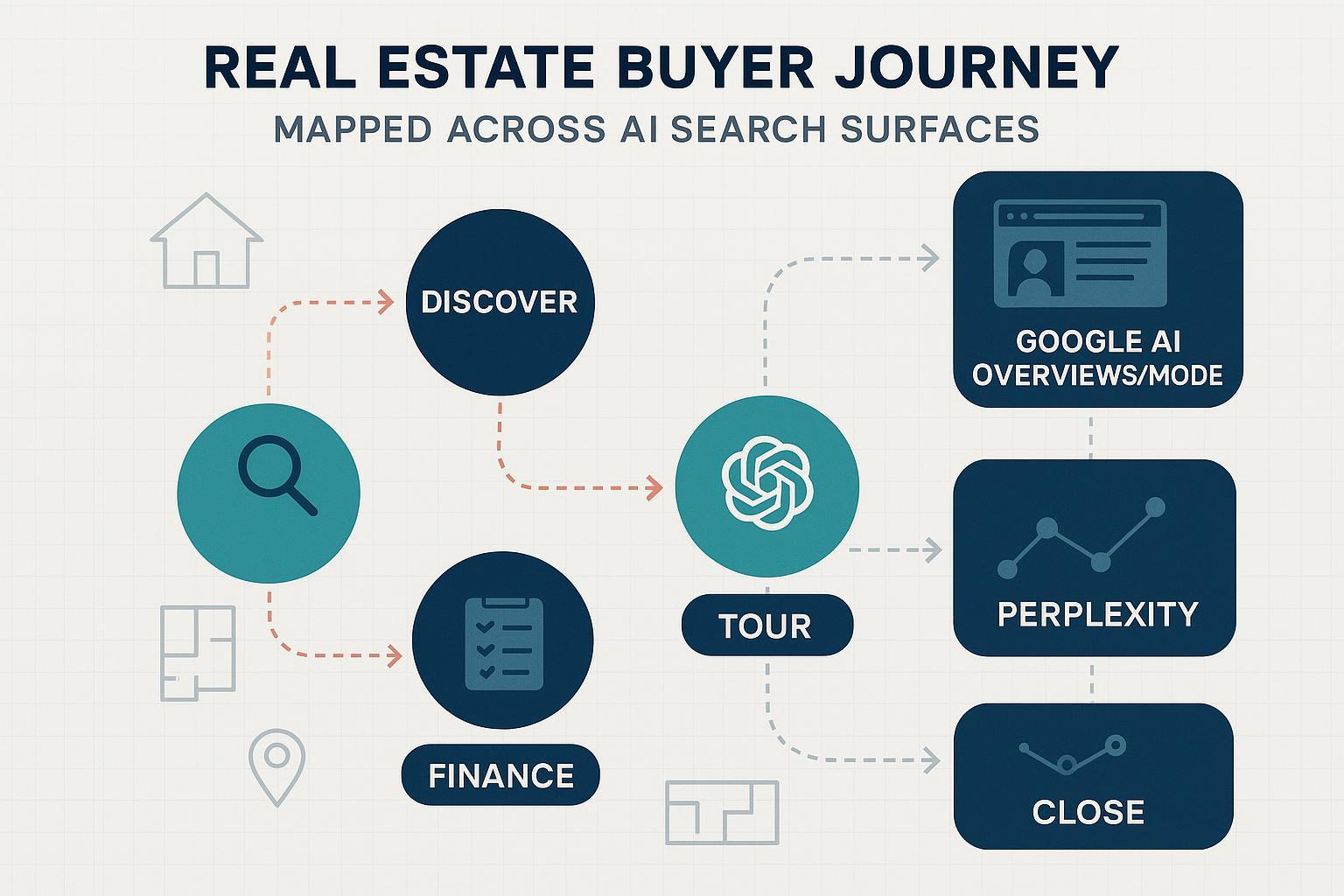
What changed isn’t “search” itself—it’s where buyers get confident enough to act. Increasingly, that moment happens inside AI answer experiences long before a click. For agencies serving real estate clients, buyer journey maps must account for zero‑click exposure, citations inside Google’s AI features, and recommendations from assistants like ChatGPT and Perplexity. Google has been clear that AI features follow standard Search eligibility and reward people‑first content; controls like nosnippet and noindex still apply, per Google’s AI features guidance (2025). Industry analyses describe compressed funnels and fewer clicks when answers are dense, though precise CTR deltas remain limited publicly; see the synthesis in SEMrush’s 2025 AI search study.
From SERPs to AI answers: What actually changed
Two fundamentals shifted: exposure now happens inside AI answers, and evidence is aggregated differently. Visibility is measured not just by rankings but by whether your brand is cited or recommended in AI Overviews/Mode and assistant responses. Google emphasizes helpful content and states AI features use standard eligibility, while suggesting broader source diversity that can change discovery patterns. Because granular CTR attribution for AI Overviews is limited, treat citation footprint and Share of Voice within AI answers as core KPIs alongside traffic. If your journey map tracks only pageviews and form leads, you’ll miss the upstream moments where assistants shape buyer intent.
Map the real estate buyer journey across AI surfaces
Define stages and the AI touchpoints that influence them. Different personas (first‑time buyer, move‑up family, investor, relocation) query assistants for market trends, school districts, comps, and financing options. Your map should align content and tracking with these intents.
| Stage | Key Personas | AI Touchpoints | Evidence Signals to Track |
|---|---|---|---|
| Discover | First‑time, relocation | Google AI Overviews/Mode; ChatGPT; Perplexity | Brand citations, sentiment, source breadth, topical FAQs |
| Consider | Family, investor | Assistant follow‑ups; local market Q&A | Neighborhood guides, school data references, compliance disclaimers |
| Shortlist | All | Property list queries; virtual tour recommendations | Listings cited, tour links surfaced, accuracy vs. MLS/IDX rules |
| Tour | All | Scheduling prompts; chat/voice assistants | Tour requests, bot hand‑offs, consent capture (TCPA) |
| Finance | First‑time, investor | Mortgage how‑tos; lender comparisons | Educational content cited, RESPA‑safe referrals, calculators used |
| Offer | All | Negotiation tips; comps queries | Comparable sales cited, legal/agent guidance caveats |
| Close | All | Closing timelines; checklist prompts | Task completion, document FAQs, human reviews of bot outputs |
| Post‑close | All | Home maintenance; community info | Service directories cited, retention nudges, sentiment shifts |
According to NAR summaries, internet remains the primary information source for buyers (51% in 2024), reinforcing the need to instrument online discovery and assistant‑led research; see NAR Quick Real Estate Statistics (2024).
Instrumentation and zero‑click metrics
Treat instrumentation as the wiring that makes the map actionable. Implement UTM and event taxonomies with source/medium parameters for assistant‑influenced sessions (e.g., utm_source=chatgpt, utm_medium=ai_answer_ref), and log micro‑events such as property saves, virtual tour starts, financing calculator use, chat escalations, and consent captured. Maintain a log of which queries surface your brand inside AI experiences across platforms, tracking citation counts, sentiment, and whether assistants recommend your listings or guides; aggregate these into Share of Voice for AI surfaces. Tag content by journey stage and evidence level (stats, compliance language, local expertise) to improve assistant‑readiness and governance aligned with Google’s AI features guidance.
Chat/voice assistants, CRM integration, and lead scoring
Assistant‑led journeys require tight hand‑offs into your CRM with clear SLAs. Configure chat/voice flows to collect intent, location, property type, budget, and consent, then route hot signals (tour requests, financing steps) to agents with time‑bound SLAs while maintaining transcripts for audit. In HubSpot, use predictive properties (Likelihood to close, Contact priority) and AI‑built lead scores to rank real estate signals—property saves, repeat neighborhood queries, tour scheduling, financing calculator completion; see HubSpot’s predictive lead scoring. For Salesforce integration, map fields bidirectionally (contacts, deals/opportunities, custom objects for properties/tours) and use sync triggers to update agent pipelines in near real‑time.
Monthly sprint loop: Reporting and optimization (example)
- Week 1: Visibility review—inventory queries where assistants cite you and where they don’t. Identify content gaps (missing FAQs, weak local guides, absent compliance notes).
- Week 2: Content sprint—produce/update trust content, neighborhood pages, financing explainers, and tour logistics FAQs with structured evidence and disclaimers.
- Week 3: Instrumentation—add tags/events, refine bot prompts, update routing SLAs, and adjust lead scoring weights.
- Week 4: Report—compare Share of Voice in AI answers, engagement events, and qualified leads to prior month; plan next sprint.
Disclosure: Geneo is our product. As an example, agencies sometimes use AI‑visibility dashboards to monitor brand mentions and Share of Voice across ChatGPT, Perplexity, and Google AI features. A neutral use case is aligning content sprints to changes in AI citations and sentiment, then exporting white‑label reports for clients. See the platform overview at Geneo (Agency).
Compliance‑by‑design: Safeguards you need
Bake safeguards into every stage. For Fair Housing and MLS/IDX, ensure assistant outputs don’t imply discriminatory preferences, apply compliance disclaimers, and validate listing data accuracy and display rules; see NAR’s guidance on AI listing apps and MLS policy. For RESPA/CFPB, keep referrals and partnerships clean—no kickbacks or unearned fees in automated flows—and review current compliance compendiums such as CFPB’s 2025 guidance compendium. For TCPA consent, obtain one‑to‑one consent and respect Do Not Call lists; log consent events tied to contact records; see NAR’s TCPA one‑to‑one consent overview. Add audit trails by storing transcripts, consent logs, and human review notes for generated content and bot responses.
Common pitfalls and how to fix them
Misattributed conversions are common because assistant‑influenced sessions often appear as “direct.” Use rigorous UTMs and server‑side tagging to fix attribution. Bots can be brittle if prompts are generic; ground them in vetted content, add retrieval augmentation, and include rule‑based fallbacks. Ungoverned prompts drift into non‑compliant language; employ prompt governance with change logs and periodic legal review. Data often sits in silos; stitch assistant transcripts, CRM, and web analytics with bidirectional syncs and custom objects for properties and tours.
Your practical audit checklist (agency‑ready)
- Journey stages mapped with AI touchpoints and personas, including evidence tags.
- UTM/event taxonomy implemented for assistant‑influenced sessions and micro‑events.
- Zero‑click citation tracking in place across Google AI features, ChatGPT, Perplexity.
- Bot flows instrumented with consent capture, transcripts, and SLA‑based routing.
- Predictive/AI lead scoring configured, with real estate‑specific signals.
- HubSpot ↔ Salesforce field mapping and sync triggers verified; error handling documented.
- Compliance disclaimers present; FHA/MLS/IDX checks embedded in content and bot flows.
- RESPA/TCPA processes reviewed; consent logs linked to contact records.
- Monthly sprint loop operational; reports compare Share of Voice, engagement, and qualified leads.
- Prompt governance established; change logs with legal review cadence.
A buyer journey map is only useful if it changes outcomes. Instrument the upstream assistant moments, wire them into your CRM and compliance scaffolding, and iterate monthly. What’s the single gap you could close this quarter that would make your assistants confidently recommend your listings?