
AI-Search Buyer Journey Mapping for Legal Services 2026
Agency-ready guide to mapping AI-search buyer journeys for law firms: stage-specific content, measurement KPIs, and compliance guardrails for ChatGPT, Perplexity, and Google AI.
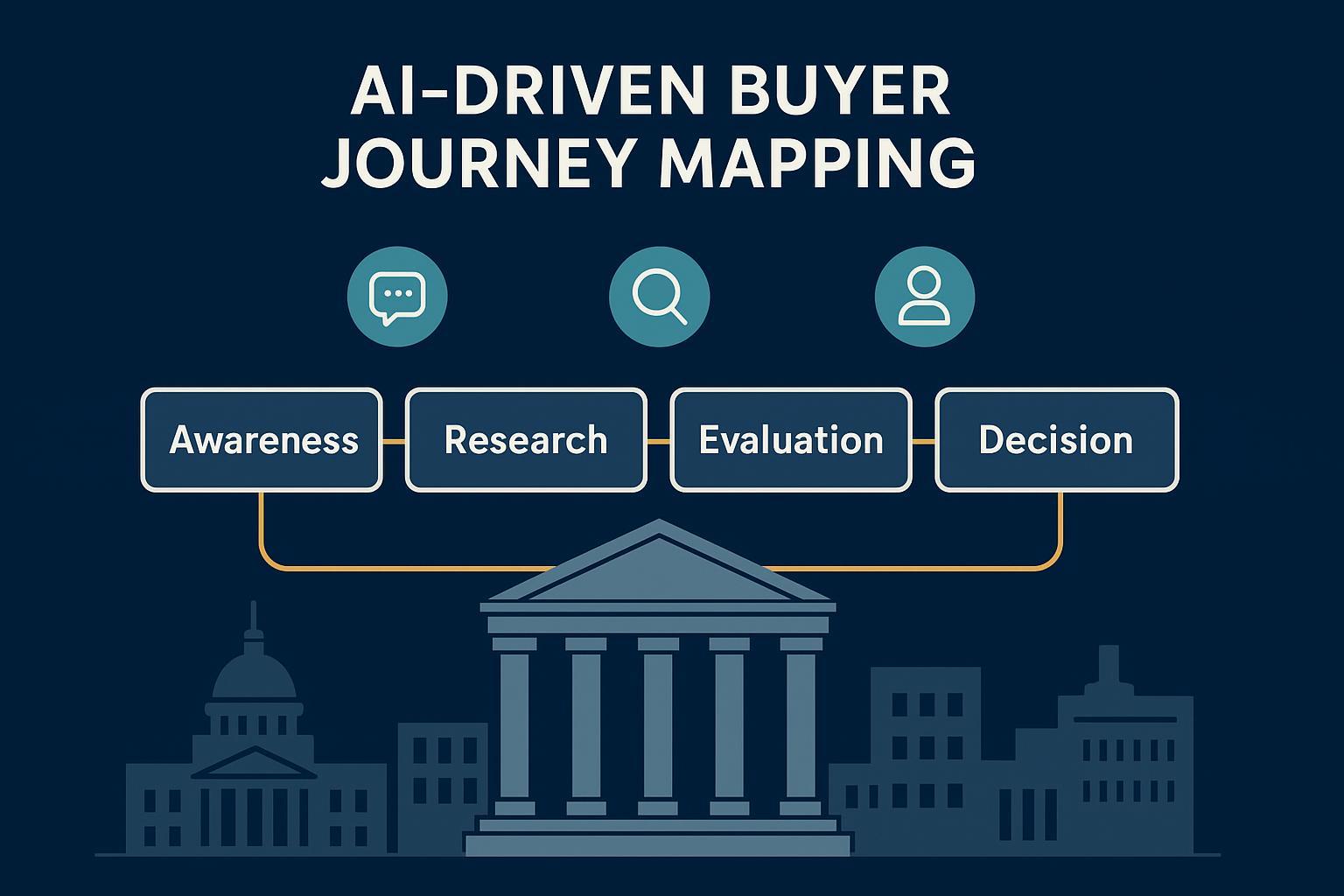
Legal buyers rarely follow a straight line. They ask friends, skim directories, and increasingly consult AI‑powered answer surfaces—ChatGPT, Perplexity, and Google’s AI Overviews—before they ever fill out a contact form. If you run SEO or digital strategy for a law firm, your task is to show up credibly in those conversations and to measure what matters.
This guide lays out AI‑search buyer journey mapping for legal services: stage‑specific content, prompt and schema tactics, a measurement playbook, and compliance guardrails your team can operationalize today.
Why AI answers are reshaping legal buyer journeys
AI Overviews now appear on a meaningful share of U.S. queries, fluctuating by update window and topic class. Independent studies in late 2025 reported ranges from the mid‑teens to roughly one‑quarter of queries showing AIO, with notable volatility across months. For context, Seer Interactive’s September 2025 study found significant CTR declines when AIO is present, while BrightEdge’s year‑in‑review noted rising zero‑click behavior even as impressions increased. See the publisher guidance in Google Developers: AI features and independent analyses from Seer Interactive (Sep 2025) and BrightEdge’s 2025 deep dive (PDF).
For legal services, referrals still matter—yet buyers validate those referrals with online research, reviews, and increasingly AI agents. Clio’s 2024–2025 Legal Trends highlights the blend of referral and digital discovery among solos and small firms. That means your journey map must reflect human plus AI behavior.
AI‑search buyer journey map for legal services
Below is a pragmatic map tuned to how conversational agents and AIO influence each stage. Use it to brief practice leads and content teams.
Awareness
Goal: be present when people ask situational, local, and definitional questions.
- Content: educational guides (“What to do after a car accident in [State]”), FAQs, glossaries, local landing pages, attorney bios with credentials. Ensure NAP consistency and clear authorship.
- Conversational prompts to target: “What are my rights after a car accident in Arizona?” “Is mediation right for a custody dispute in Austin?” “How do contingency fees work for injury cases in Chicago?”
- Tactics: author‑signed, date‑stamped articles; FAQ schema (JSON‑LD); LegalService + Organization schema; keep content crawlable and updated; maintain authoritative directory profiles.
Research
Goal: help prospects compare options and understand processes.
- Content: comparison pages (contingency vs. hourly), process explainers, eligibility checklists, intake guides, jurisdiction‑specific overviews.
- Prompts: “Contingency fee vs hourly for personal injury—pros and cons,” “Steps to file for divorce in Travis County,” “Is expungement possible for a first‑time offense in Ohio?”
- Tactics: cite statutes and official resources; link to court and government pages; embed review/testimonial elements compliant with state rules; ensure intake forms are privacy‑safe.
Evaluation
Goal: earn trust signals and third‑party validation.
- Content: attorney bios tied to practice pages, case‑type summaries (with disclaimers), FAQs that answer comparative queries, curated reviews.
- Prompts: “Top‑rated immigration lawyers in Phoenix,” “Who is reputable for estate planning in Boston?”, “Which firms have strong results in wrongful death cases?”
- Tactics: reinforce entity clarity (Person, Organization schema), show credentials (bar memberships, publications), include representative matters with “past results do not guarantee” disclaimers, and maintain GBP/category accuracy.
Decision
Goal: make contacting you effortless and transparent.
- Content: scheduling pages, fee transparency, service area clarity, short explainer videos, trust badges, intake microcopy that sets expectations.
- Prompts: “How to schedule a consultation with a family lawyer in Seattle,” “What to bring to a first meeting with a DUI attorney,” “Do you offer payment plans for estate planning?”
- Tactics: instrument attribution fields (“How did you find us? ChatGPT/Perplexity/Google AI Overviews”), streamline forms, provide phone + chat + calendar options, and ensure mobile speed and accessibility.
Retention and Advocacy
Goal: sustain reputation signals AI agents rely on.
- Content: post‑matter follow‑ups, client education updates, review requests, newsletters on legal changes.
- Prompts: “What happens after settlement closes?” “When should I update my will after relocation?” “How to leave a review for my lawyer on Google and Avvo?”
- Tactics: request reviews on authoritative platforms; refresh cornerstone articles; keep bios, awards, and directories updated; maintain consistent citations.
Prompt‑to‑content mapping (template)
Use this compact map to brief writers and align with conversational intent.
| Buyer stage | Example prompt | Content to publish | Schema/structure |
|---|---|---|---|
| Awareness | “What are my rights after a car accident in Arizona?” | State‑specific guide + FAQ | LegalService, FAQPage, Organization |
| Research | “Contingency fee vs hourly for personal injury” | Comparison page + calculator | WebPage, Review, Organization |
| Evaluation | “Top‑rated immigration lawyers in Phoenix” | Bio hub + reviews + credentials | Person, Organization, AggregateRating |
| Decision | “Schedule a consultation with a family lawyer in Seattle” | Booking page + intake checklist | LocalBusiness, ContactPoint |
| Retention | “How to leave a review for my lawyer on Google” | Post‑matter email + review page | Organization, HowTo |
Measurement and attribution playbook
Shift reporting from pure rankings toward inclusion, citation quality, and downstream conversions. A practical baseline is a 6–8 week audit across priority practices and geos, followed by monthly monitoring.
Key KPIs
- AI Inclusion Rate: % of sampled prompts/queries where your firm is cited or recommended.
- AI Citation Frequency and Sentiment: count and tone of mentions across ChatGPT, Perplexity, and AIO.
- Share of Voice in AI: your mentions vs. competitors across engines.
- AI‑origin Leads and Conversion Rate: attributable via tagged landing pages and self‑reported “found us via ChatGPT/Perplexity/Google AI.”
- Branded Search Lift: changes in branded impressions after visibility gains.
Dashboard fields to log
- Query/prompt, engine (ChatGPT/Perplexity/Google AI), date
- Citation present (Y/N), snippet text, sentiment
- Position/context (e.g., “recommended firms list”), landing page
- Conversions attributed (form, call, booking)
Disclosure: Geneo is our product. One way teams collect these signals is to use an AI‑visibility monitor that tracks daily mentions across ChatGPT, Perplexity, and AIO, aggregates them into a trendable score (e.g., Share of Voice, AI Mentions), and supports white‑label client reporting—see the neutral product overview at Geneo for agencies. For deeper KPI definitions, review the AI search KPI framework.
For differences between engines, including how citations surface, see this comparative guide to ChatGPT vs. Perplexity vs. Google AI Overviews.
Compliance and ethical guardrails
Legal content is YMYL. Treat AI outputs as tertiary sources and verify everything. Anchor your marketing to established rules and state guidance.
- ABA Model Rules (7.1–7.5): communications must be truthful and not misleading; avoid unverifiable comparisons; identify the responsible lawyer/firm; manage solicitation carefully. Reference the official repository via the American Bar Association Model Rules.
- Florida Bar Ethics Opinion 24‑1 (Jan 2024): permits generative AI with duties of competence, confidentiality, and oversight; requires disclaimers for public‑facing chatbots to avoid misleading the public and bars unverifiable superlatives. See Florida Bar Opinion 24‑1.
- State Bar of California Practical Guidance (Nov 2023): emphasizes competence, confidentiality, supervision, and accuracy/bias review in generative AI use. Official guidance is available in the State Bar of California Practical Guidance PDF.
- Texas Opinion No. 705 (Feb 2025): stresses verification and competence; treat AI‑assisted outputs as starting points to be independently checked. See Texas Opinion 705.
Practical checklist
- Label content as information, not legal advice; include “past results do not guarantee outcomes” where applicable.
- Verify statutes and processes with official sources; document human review of any AI‑assisted drafts.
- Keep testimonials compliant with your state’s advertising rules; avoid guarantees and comparative claims you can’t substantiate.
- Maintain privacy in intake forms; avoid collecting sensitive data before conflict checks.
Agency SOP and 90‑day implementation roadmap
The following workflow helps agencies stand up AI‑search journey mapping without over‑engineering.
Phase 0: Onboarding (Week 0)
- Access: GA4, call tracking, CRM, Google Business Profiles; confirm priority practice areas, geos, competitor set; assemble a baseline prompt list per engine.
Phase 1: Baseline audit (Weeks 1–6)
- Poll ChatGPT, Perplexity, and AIO for your prompt set on a cadence; log citations, sentiment, and context; map landing pages; identify content gaps and schema needs.
Phase 2: Content and entity fixes (Weeks 3–10)
- Publish 3–5 cornerstone guides per practice with local modifiers; add FAQ and LegalService/Organization/Person schema; tighten directory profiles; update bios and review flows.
Phase 3: Attribution and CRO (Weeks 6–12)
- Add “How did you find us?” fields with AI options; tag landing pages; streamline scheduling and intake; set up monthly reporting on inclusion, citations, and conversions.
Phase 4: Iterate (ongoing)
- Refresh high‑intent content quarterly; expand prompts; localize for adjacent cities; solicit reviews post‑matter; review compliance updates.
Bringing the map to life
AI‑search buyer journey mapping for legal services isn’t about chasing every algorithm tweak. It’s about showing up with credible, locally relevant answers, structuring your site so AI agents and humans can verify you, and measuring inclusion and conversions—not just clicks. Start with a 6–8 week baseline, fix the content and entity foundations, instrument attribution, and keep a steady cadence of improvements backed by compliance.