
AI-Search Buyer Journey Mapping for Healthcare Companies
Master AI-search buyer journey mapping for healthcare with workflow guides, compliance steps, and visibility tactics across Google AI Overviews, ChatGPT, and Perplexity.
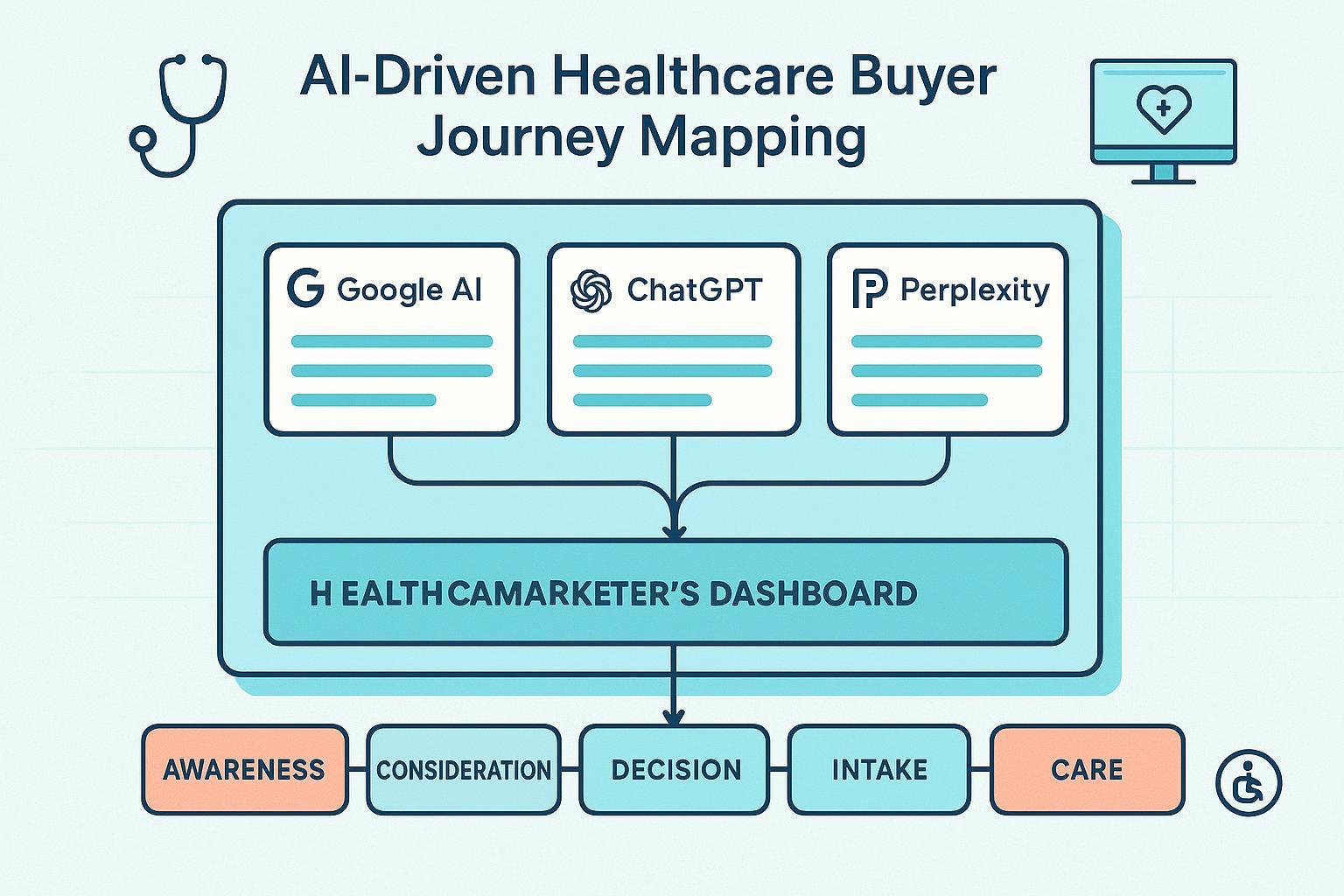
Healthcare discovery no longer starts on a homepage or even a classic search results page. Increasingly, it begins inside AI answers—where an assistant synthesizes options, cites a handful of sources, and nudges the next step. If your content isn’t understood and cited by these systems, you’re invisible at the moment that matters.
This guide lays out a practical, compliant workflow to map patient and buyer journeys across AI surfaces—Google AI Overviews, ChatGPT Search, and Perplexity—so your team can design content, instrumentation, and governance that stand up to real-world scrutiny.
Who and what you’re mapping
- Segments: patients (B2C), providers (B2B), payers (B2B), healthtech/pharma (B2B2C)
- Stages: Awareness → Consideration → Decision → Onboarding/Intake → Care/Retention
Compliance-by-design underpins every stage. That includes respecting HIPAA limits on tracking technologies and BAAs on properties where protected health information could leak—see the U.S. regulator’s detailed clarification in the HHS OCR guidance on online tracking technologies (updated 2024–2025) for what is and isn’t permissible on public vs. authenticated pages, and why a risk analysis is essential. For background, refer to the official HHS page: the Use of Online Tracking Technologies by HIPAA Entities and Business Associates, which explains obligations around disclosures and Security Rule risk analysis in plain language (HHS OCR guidance).
A five-step workflow your team can adopt this quarter
Step 1: Define intents that AI systems can answer cleanly
Start with personas and their questions per stage. Capture the exact prompts you see in real conversations, not just keywords: “Which urgent care near me treats stitches on weekends?” “Compare CPT codes and coverage for X procedure.” “What are the risks and alternatives to Drug Y for adults with Z?”
For each intent, note:
- What constitutes a helpful, citeable answer (facts, comparisons, safety notes)
- The page(s) on your site best positioned to be quoted
- Regulatory flags (e.g., Rx benefit/risk balance; testimonial disclosures; PHI exposure risk)
Tip: Think of each intent as a mini Q&A card that an assistant could lift and cite. If your page doesn’t contain a concise, evidence-linked answer block, the AI will cite someone else.
Step 2: Map touchpoints and content to stages—with guardrails
Lay out the touchpoints (AI answers, SERPs, social, landing pages, forms, portals, call center, SMS) and connect them to stage-specific content. Then overlay guardrails:
- Tracking tech: On sites or apps that could expose PHI, confirm either a compliant vendor with a BAA or the removal of trackers likely to send identifiers off-site (per the HHS OCR tracking tech guidance linked above).
- Endorsements: If you use testimonials, influencers, or UGC, make sure disclosures are clear, conspicuous, and unavoidable; health benefit claims require competent and reliable scientific evidence, per the FTC’s Endorsement Guides (updated 2023) (FTC Endorsements hub).
- Non‑HIPAA apps: If you operate a wellness app or PHR‑like service outside HIPAA, understand when unauthorized disclosures trigger breach notifications under the revised Health Breach Notification Rule (effective 2024) (FTC HBNR update).
Step 3: Design content AI assistants prefer to cite
Each surface has mechanics worth respecting. In short: produce concise, verifiable answers with sources front and center; add structure that machines can parse; and handle safety context when relevant.
- Google AI Overviews: There are no special “opt-ins”; inclusion flows from regular search eligibility and overall page quality. Focus on people-first content, clear intent coverage, and technical hygiene, per Google’s documentation on AI features and your website (Google Search Central: AI features).
- Perplexity: Its Deep Research composes cited reports by reading broadly and linking inline. Pages with explicit claims, comparison tables, clear timestamps, and authoritative sources are more quotable (Perplexity Deep Research).
- ChatGPT Search: It surfaces timely answers with linked sources. Concise sections, clear headings, and verifiable statements raise your odds of being referenced (ChatGPT Search announcement).
Add schema where appropriate (e.g., medical types), credentialed authorship and medical review blurbs, and prominent “last reviewed” dates. For Rx or device content, maintain benefit/risk balance even in short blocks; OPDP’s recent actions against social posts with omitted risks show how tight the margin is for error, as summarized in an industry analysis of FDA’s 2025 warning and untitled letters targeting DTC promotions (FDA Law Blog overview).
Step 4: Wire in technical signals, accessibility, and governance
- Technical: Use structured data, canonicalization, clean internal linking, and stable URLs so assistants can resolve the right page.
- Accessibility: Treat WCAG 2.1/2.2 AA as your minimum—especially for forms, scheduling, and portal entry. The DOJ’s 2024 web and mobile rule guidance is a practical reference for what “perceivable, operable, understandable” should look like in public-sector-aligned experiences (DOJ web/mobile accessibility fact sheet). For a concise standard overview, see the Access Board’s summary of WCAG 2.2 (2023) (U.S. Access Board on WCAG 2.2).
- Governance: Maintain medical review logs, version histories, and a content provenance note when AI-assisted writing/editing was used. For social or short formats, confirm you can present balanced risk/benefit within the available space—or choose a different medium.
Step 5: Measure AI visibility and connect it to outcomes
Define a model that tracks both presence and impact:
- Presence: Frequency and quality of brand citations across AI surfaces; which intents/stages produce mentions; where competitors are cited instead.
- Impact: Downstream signals tied to cited answers—qualified inquiries, appointment completions, portal registrations, and call center topics.
- Auditability: Keep date-stamped captures of AI answers and your cited content sections so you can trace causality and defend changes.
Correlate visibility shifts with operational metrics. If your scheduling conversion rises after a cited “How to prepare for your MRI” page is updated and starts appearing in AI answers, document that connection and keep the page fresh.
How the three AI surfaces include and cite content (at a glance)
| Surface | How content is included | How citations appear | Practical optimization cue |
|---|---|---|---|
| Google AI Overviews | Via regular Search eligibility and quality signals | Multiple source links under the synthesized answer | Publish comprehensive, people-first pages; ensure crawl/index; add schema and explicit Q&A blocks |
| ChatGPT Search | Assistant triggers browsing and retrieves sources for timely answers | Linked sources appear inline in the answer | Provide concise, verifiable sections with clear headings and recent review dates |
| Perplexity | Deep Research reads widely and composes cited reports | Inline, clickable citations to original sources | Use structured, comparison-friendly content and clear timestamps |
Think of this table as your “content contract” with the assistants. If a claim isn’t verifiable and timestamped, expect a different source to earn the citation.
Micro‑case: Telehealth intake, end to end
Scenario: A regional health system wants more appropriate telehealth bookings for dermatology.
- Awareness: Publish a plain‑language page answering “What’s appropriate for telehealth dermatology?” Include common conditions, when to seek in‑person care, and safety cautions. Add citations and a last‑reviewed date.
- Consideration: Create a comparison page: telehealth vs. in‑person for specific conditions. Include cost and time factors, with links to payer policies where applicable.
- Decision: Design an accessible scheduling flow with minimal fields, clear error handling, and explicit consent. Avoid embedding trackers that could transmit PHI.
- Onboarding/Intake: Provide a prep checklist and device test page; keep trackers off login and pre‑visit forms that request sensitive info.
- Care/Retention: Follow up via secure messaging; publish a post‑visit FAQ that AI assistants can cite for aftercare questions.
What changed? Within six weeks of launch, AI surfaces began citing the telehealth appropriateness page for related queries. Appointment completion rates improved as decision friction dropped, and phone triage time fell because patients arrived better prepared. The operational lift mattered more than the traffic chart.
Tooling note (neutral, disclosed)
Disclosure: Geneo is our product. For agencies and in‑house teams that need to monitor how often brands are cited across ChatGPT, Perplexity, and Google AI Overviews and then share those trends with stakeholders, a white‑label AI visibility dashboard can help standardize reporting (e.g., tracking Share of Voice, total AI mentions, and a composite visibility score over time). Use this type of tool alongside your analytics and CRM so you can tie AI answer presence to qualified inquiries and completed appointments rather than chasing screenshots.
Governance checklist you can run monthly
- Content integrity: Every critical page includes a concise, citeable answer block; medical reviewer listed; last‑reviewed date updated.
- Tracking tech controls: Validate no PHI flows to third parties; keep BAAs current where applicable; re‑run risk analysis after major changes (see HHS OCR tracking tech guidance linked earlier).
- Promotional fairness: For Rx/device content, confirm benefit/risk balance; for testimonials/influencers, disclosures are clear and unavoidable (FTC Endorsements).
- Accessibility: Re‑test high‑friction flows (scheduling, intake, payment) against WCAG 2.2 AA; fix color contrast, focus indicators, and error messaging.
- AI-surface coverage: Review which intents earned citations per platform; refresh stale pages; add missing Q&A blocks.
- Evidence trail: Maintain date‑stamped captures of AI answers and your source sections; log updates and reviewer approvals.
What successful teams do next
Pick one service line, one payer use case, and one patient scenario. Build intent lists, ship three pages with citeable blocks, and instrument outcomes you can trust. Two weeks later, test how assistants answer those questions and adjust.
Here’s the deal: AI assistants are already shaping buyers’ first impressions. Will they quote you—or your competitor?
References cited in-context: HHS OCR tracking technologies guidance (HIPAA); FTC Endorsements and HBNR updates; Google’s “AI features and your website”; Perplexity Deep Research; OpenAI’s ChatGPT Search announcement; FDA Law Blog 2025 enforcement overview; DOJ web/mobile accessibility fact sheet; U.S. Access Board on WCAG 2.2.