
Ultimate Guide to AI Search Buyer Journey Mapping for FinTech
Discover the complete guide to mapping AI-search buyer journeys for FinTech firms. Learn practical strategies, compliance checkpoints, and expert workflows for agencies. Unlock visibility and pipeline-ready KPIs—start transforming your FinTech marketing.
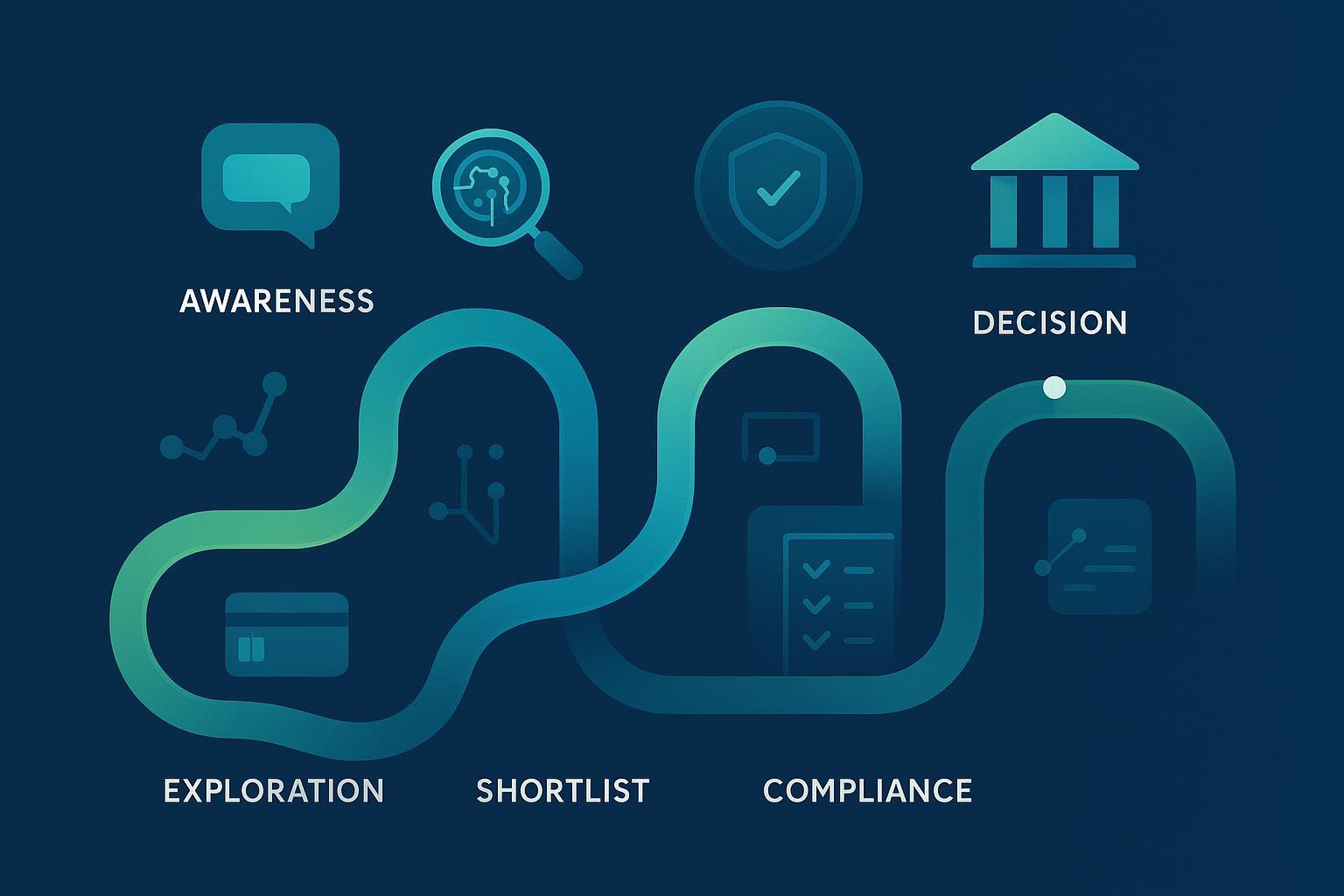
The buyer journey has moved into chat. FinTech prospects now ask AI engines for definitions, shortlists, comparisons, compliance checklists, and even draft business cases—often before your team knows an evaluation has started. If your journey map still centers on blue links and last‑click forms, you’re missing where decisions are actually being shaped.
This guide shows FinTech marketing, growth, and RevOps leaders (and their agencies) how to map the modern journey with AI answer engines in mind—and how to operationalize it with evidence, workflows, and KPIs.
What really changed with AI answer engines—and what GEO means
Answer engines compress discovery by synthesizing results into conversational answers, keeping more research in the interface and fewer clicks to websites. Google introduced AI Overviews (Gemini‑powered) to mainstream search in 2024 with planning and multimodal capabilities, shifting how users explore topics and sources (Google’s May 2024 update). Communications of the ACM described this move as a structural turn from ranked lists to “answer engines,” noting reduced click‑through and the rise of agentic research behaviors (CACM overview, Nov 2025).
For site owners, Google emphasizes there’s no special markup to “opt into” AI features; the same foundations—crawlability, quality, and helpful content—determine source selection, and AI Overviews link out via source cards to original pages (Google Search Central: AI features & your website). Perplexity, by contrast, is transparent with inline citations and a Deep Research mode that compiles referenced reports with links (Perplexity Deep Research). ChatGPT can cite sources depending on tools/browsing configuration, but it’s less consistently transparent than Perplexity.
Think of it this way: traditional SEO was like jockeying for one of ten podium spots on a racetrack. GEO (generative/answer engine optimization) is more like being quoted by a panel of experts—if your explanations and evidence are clear, structured, and authoritative, you’re more likely to be cited in the synthesized answer. For a concise comparison of classic SEO vs modern GEO metrics and tactics, see the context piece on Traditional SEO vs GEO.
A FinTech‑specific journey model and committee map
FinTech deals are multi‑threaded and compliance‑heavy. Map your journey as non‑linear cycles across these stages: Awareness → Problem Framing → Solution Exploration → Vendor Shortlist → Security/Compliance Due Diligence → Business Case/Consensus → Decision → Onboarding/Expansion.
Key stakeholders enter earlier than you might expect: IT/InfoSec, Compliance, Legal/Privacy, Procurement, and Finance influence feasibility and risk tolerance even during “Exploration.” Industry research continues to show that B2B buyers prefer self‑serve research and often bring larger committees into evaluations; G2’s 2024 report highlights longer cycles and strong CFO involvement in decisions (G2 Buyer Behavior 2024). For FinTech specifically, early information needs cluster around category clarity and integration fit for marketing/product teams; proof of fast activation and references for sales leadership and RevOps; SOC 2 Type 2 availability, ISO/IEC 27001 alignment, data flows, sub‑processors, and incident response for IT/InfoSec and Compliance; and contract terms, DPAs, TCO/ROI evidence, and risk mitigation for Procurement and Finance.
Build your AI touchpoint inventory and tagging schema
Your map needs a living inventory of AI‑search touchpoints. Tag each surfaced item so you can prioritize work and measure progress.
- Channel: AI Overview (Google), Perplexity, ChatGPT, plus traditional SERP/supporting channels.
- Engine mode: overview, answer, Deep Research, browsing.
- Content type: explainer, comparison, case study, integration guide, trust‑center page, policy.
- Evidence level: claims, quantified outcomes, third‑party references, audit artifacts.
- Compliance relevance: SOC 2, ISO 27001, PCI DSS, GDPR/CPRA, AML/KYC, AI governance.
- Journey stage: which stage the touchpoint influences.
| Field | Options/Examples | Why it matters |
|---|---|---|
| Engine | Google AI Overviews, Perplexity, ChatGPT (browsing) | Determines citation behavior and tracking method |
| Content type | Explainer, Comparison, Case Study, Trust Center, Policy | Aligns creation with stage needs |
| Evidence level | Claims, Quantified, Third‑party, Audit Artifact | Prioritizes trustworthy sources for AI inclusion |
| Compliance tag | SOC 2, ISO 27001, PCI DSS, GDPR/CPRA, AML/KYC, AI RMF | Surfaces due‑diligence content early |
| Stage | Awareness → Expansion | Links visibility to pipeline movement |
| Action owner | SEO/GEO, PMM, Security, Legal, RevOps | Drives accountability |
Keep the schema lean but consistent. If you’re wondering whether to log a touchpoint that seems minor, log it. Small citations often ladder into shortlists.
Workflow: capture AI citations and update the map monthly
Here’s a field‑tested cadence you can run in‑house or with an agency:
-
Define query sets by stage and persona. Include plain‑language prompts buyers actually use (e.g., “best fraud prevention platform for fintech,” “SOC 2 checklist for SaaS vendors,” “PCI DSS responsibilities for service providers”).
-
Monitor across engines weekly. For Perplexity, record every cited source and the snippet context; for Google AI Overviews, capture the source cards and the sub‑topic that triggered inclusion; for ChatGPT, note whether browsing/citations were present and save outputs where allowed. Coverage differences and citation transparency vary by engine; for a comparative overview, see this breakdown of ChatGPT vs Perplexity vs Gemini vs Bing monitoring.
-
Log, tag, and score. Use your schema: engine, content type, evidence level, compliance tag, and stage. Add notes on sentiment and position prominence if visible.
-
Review monthly. Identify gaps (e.g., no trust‑center pages are cited for PCI prompts) and spin a content sprint to close them. Update internal links and schema markup on target pages where appropriate.
-
Share a QBR‑ready summary. Show visibility deltas by engine and which pages drove stage progression.
Practical example (neutral). Disclosure: Geneo is our product. An AI‑search visibility tracker can be used to collect daily mentions/citations across ChatGPT, Perplexity, and Google AI Overviews, tag each citation to a journey stage, and export a white‑label dashboard for executive reviews. For a practitioner overview of such workflows, see the agency‑oriented write‑up on AI‑search visibility tracking. Alternative approaches include building internal scrapers with a RAG pipeline or running manual audits; whichever route you choose, insist on multi‑engine coverage, durable evidence capture (URL + screenshot), historical trends, and shareable exports.
Content to win each stage—with compliance checkpoints
Your goal is twofold: appear in AI answers and give buying committees the evidence they need to progress without friction.
Awareness and Problem Framing
- Publish answer‑first explainers with clear definitions, structured headings, and concise 40–80‑word summaries at the top. Google’s site‑owner guidance confirms there’s no special markup for AI Overviews; standard Search eligibility and helpful content apply (AI features & your website).
- Use Q&A and comparison‑friendly formats and link to authoritative references.
Solution Exploration and Shortlist
- Create side‑by‑side comparisons, “best for” use‑case breakdowns, and integration matrices. Perplexity’s Deep Research can surface and cite these if clearly structured and well‑sourced (Perplexity Deep Research).
- Ensure product overview pages include entity‑clear metadata, technical diagrams, and links to trust‑center resources.
Security/Compliance Due Diligence
- Make your Trust Center machine‑readable. Include SOC 2 (preferably Type 2) status, scope, and report access policies; align with the Trust Services Criteria categories (AICPA Trust Services Criteria).
- Document ISO/IEC 27001:2022 control coverage with a succinct Statement of Applicability summary and data‑flow diagrams (ISO/IEC 27001:2022 publication).
- If you touch payments data, outline your PCI DSS v4.0 responsibilities, hosting model, and SAQ/AOC posture with links to official documentation hubs (PCI SSC v4.0 resource hub).
- For AML/KYC alignment (RegTech/data providers), describe risk‑based CDD/EDD principles and how your product supports institutional obligations with references to recognized bodies (FinCEN CDD expectations).
Business Case/Consensus
- Publish case studies with quantified outcomes and reproducible setups; include TCO/ROI models and procurement‑friendly executive summaries.
- Offer integration blueprints and security review timelines to set expectations.
Decision, Onboarding, and Expansion
- Provide implementation guides, role‑based FAQs, and runbooks. Ensure post‑sale content is discoverable; AI engines often cite public docs that reduce friction for adjacent use cases.
Execution tactics to support inclusion in AI answers: answer‑first content blocks, schema markup that matches visible content, expert bylines, and periodic refreshes tend to improve clarity and extraction. For an executive‑level how‑to, see the guide to AEO best practices.
Measurement plan: KPIs you can defend in the QBR
Tie visibility to movement through the journey. Avoid vanity metrics in isolation.
Visibility (top of funnel)
- Share of Voice in AI answers by engine; total AI mentions/citations; platform breakdown; sentiment mix where available. Practitioner reports note that AI Overviews can reduce clicks relative to traditional results, so measuring inclusion and source prominence is essential (Search Engine Land on AI Overviews and clicks).
Demand (mid‑funnel)
- Assisted conversions from AI‑sourced sessions; qualified demo requests from pages that AI engines cite; shortlist inclusion rates in “best of” prompts over time.
Enablement (due diligence)
- Percentage of security/compliance prompts that surface your Trust Center; time‑to‑security approval; number of InfoSec questions resolved via public documentation.
Cycle health (late stage)
- Stage progression velocity before/after AI‑search content updates; meeting‑less shortlist confirmations captured in discovery; variance in procurement timeline once compliance evidence is published.
Operationalize the dashboard by tagging each AI citation to a stage and attributing your content sprints to subsequent KPI moves. Correlation isn’t causation—but when the same trust‑center page begins appearing in Perplexity answers and your InfoSec cycle time drops, that’s a pattern you can bring to the table.
Platform nuances that affect mapping
- Perplexity is the most citation‑transparent. It shows inline sources and, in Deep Research, compiles extensive references with links. That makes it ideal for auditing which of your pages (or competitors’) are framing the conversation in real time.
- ChatGPT’s citation behavior depends on browsing/tools configurations; treat it as a qualitative channel where you monitor narrative shape, messaging, and whether canonical profiles (e.g., analyst coverage) are informing summaries.
- Google AI Overviews select sources based on broad exploration of subtopics and present source cards that encourage click‑through to original content. There’s no special “AI Overview” markup; standard Search practices apply (Google Search Central: AI features & your website).
For a practitioner’s look at coverage and monitoring differences across engines, compare approaches in this engine monitoring overview.
Neutral tool and method selection criteria
Whether you adopt a vendor platform, build an internal crawler with a RAG pipeline, or run disciplined manual audits, evaluate options against these criteria:
- Engine coverage: ChatGPT, Perplexity, and Google AI Overviews at minimum.
- Evidence retention: durable logs with URLs and screenshots; citation text context.
- Historical tracking: daily/weekly cadence with trend views and deltas.
- Sharing/export: stakeholder‑friendly dashboards and exports without PII leaks.
- Multi‑client support: role‑based access, white‑labeling, and CNAME hosting (agencies).
- Cost per tracked query: scalable pricing that won’t limit your coverage.
Here’s the deal: if you can’t point to a monthly trendline of what AI engines say about your clients—and the exact pages they cite—you can’t credibly connect visibility work to pipeline outcomes.
Next steps
- In the next 30 days: finalize your stage definitions, build the tagging schema, and instrument weekly monitoring across engines. Ship one trust‑center upgrade and one answer‑first explainer.
- In 60–90 days: run two content sprints to close the biggest stage gaps, refresh schema on high‑value pages, and publish at least one quantified case study.
- Quarterly: review visibility and pipeline KPIs by stage; update the journey map; retire tactics that don’t move numbers.
Optional: If you’re consolidating AI‑search visibility for multiple stakeholders, consider centralizing tracking in a white‑label dashboard to simplify QBRs and reduce screenshot churn.