
AI-Search Buyer Journey Mapping Best Practices for Education
Discover authoritative best practices for mapping AI-influenced buyer journeys in education. Learn actionable frameworks, analytics, compliance, and optimization strategies.
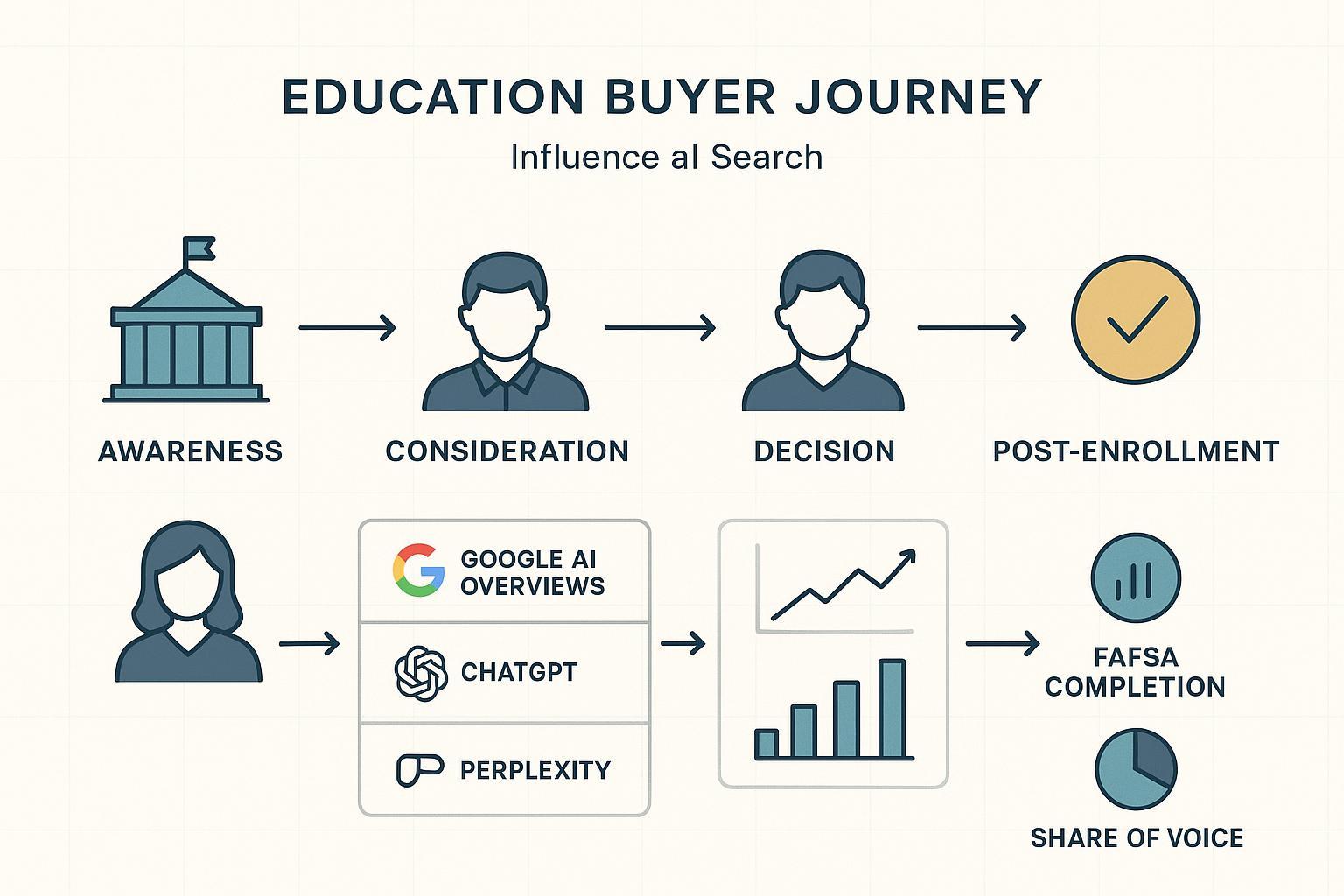
How do students actually find, shortlist, and enroll today? A growing share begin with AI assistants and AI‑shaped results. Recent U.S. data shows roughly two‑thirds of teens have used chatbots like ChatGPT, and about a quarter have used them for schoolwork—a marked jump since 2023, according to Pew Research Center’s 2025 teen survey. Meanwhile, industry studies report substantial click‑through declines when Google AI Overviews appear—underscoring that visibility and citations in AI answers matter as much as traditional rankings, per Search Engine Land’s 2025 analysis of AIO CTR drops. If your journey maps don’t account for these AI touchpoints, you’re optimizing for an internet that fewer prospective students actually experience.
Personas and AI touchpoints: who uses what, when
Think of AI discovery like a conversational “first pass” that shapes shortlists. But not every persona leans on the same channels. Here’s a practical matrix you can tailor to your institution or education company.
| Persona | Primary goals | High‑propensity AI touchpoints | Supporting channels | Notes |
|---|---|---|---|---|
| Prospective student (traditional) | Explore programs; compare outcomes; affordability | ChatGPT Search answers with cited sources; Google AI Overviews; Perplexity | TikTok/YouTube tours; school site; counselor chats | Heavy use of prompts like “best online X for Y”; expects quick, trustworthy summaries |
| Adult learner / career switcher | ROI, time‑to‑skill, flexibility | ChatGPT/Perplexity for curated lists; Gemini/Google AIO | LinkedIn, industry forums, employer tuition pages | Values transparent costs, stackable credentials, credit‑for‑prior learning |
| Parent/guardian | Safety, cost, support services | Google AIO summaries; ChatGPT Q&A | Facebook groups, financial aid pages, virtual events | Looks for FAFSA guidance and student services clarity |
| Advisor/counselor | Program fit and prerequisites | Perplexity citations; institutional facts pages | Internal knowledge base; webinars | Prefers authoritative, up‑to‑date facts for quick recommendations |
| Alumni (continuing ed) | Upskill pathways; discounts | ChatGPT/Perplexity for options | Email campaigns; LMS notifications | Responds to clear pathways linking prior credits to new certificates |
Two implications jump out:
- If your authoritative facts are buried or inconsistent, LLMs won’t cite you. Maintain canonical program pages and fresh resource hubs.
- If you only track clicks, you’ll miss exposure via AI citations. Visibility must include “LLM citations” and “AI mentions,” not just sessions.
Journey stages reimagined for AI search
Awareness: conversational discovery and cited sources
Prospective students increasingly start with prompts like “best cybersecurity bootcamps for career changers.” To appear in citations and overviews:
- Publish high‑quality, people‑first pages and guides with accurate structured data and clean technical foundations, aligning with Google Search Central’s guidance on succeeding in AI search (2025).
- Create canonical “facts” pages (program length, costs, outcomes, accreditation) and in‑depth comparison content. ChatGPT Search and Perplexity favor recency and verifiable sources; see OpenAI’s 2024 announcement of ChatGPT search with citations and Perplexity’s RAG explainer.
- Instrument discovery queries with analytics tags and monitor which prompts generate citations versus clicks.
What to measure at Awareness:
- Share of Voice in AI surfaces (by query theme)
- AI Mentions and Total Citations (by engine)
- Click‑through from AI citation links to site pages
Consideration: comparative answers and trust signals
At this stage, LLMs produce curated lists and nuanced pros/cons. Your content should:
- Provide transparent comparison data: curricula, instructor credentials, employer partnerships, transfer/credit policies.
- Surface real student outcomes and cohort stats with dates and methodology. If you can’t back a claim, LLMs may down‑rank or skip citing you.
- Keep facts updated quarterly; decay and outdated pages reduce citation likelihood.
What to measure at Consideration:
- Form starts/completions from AI‑sourced sessions
- Event registrations and advisor bookings traced to AI citations
- Repeat engagement via chatbots or resource hubs
Decision: reduce friction with conversational support
Evidence from higher ed shows well‑designed chatbots and text nudges improve critical tasks. Georgia State University’s randomized trials reported melt reductions and lifts in enrollment and FAFSA filing, as summarized in Mainstay’s case study. Apply that lesson:
- Embed proactive chatbot sequences for FAFSA, deposit, registration, and document checks.
- Offer human fallback and clear consent; announce status changes programmatically for accessibility.
What to measure at Decision:
- Deposit‑to‑enrollment yield
- FAFSA completion rates and verification clearance
- Summer melt reduction
Post‑enrollment: retention nudges and pathways
Keep momentum with prompts and micro‑interventions:
- Remind students about advising, payment holds, and re‑registration windows.
- Promote bridge certificates and alumni pathways tied to prior credits.
What to measure post‑enrollment:
- Term‑to‑term persistence and re‑registration
- Course completion and advising attendance
KPI framework and instrumentation
| Stage | Visibility metrics | Engagement/Outcome metrics |
|---|---|---|
| Awareness | Share of Voice in AI surfaces; AI Mentions; Total Citations; citation‑to‑click rate | New sessions from AI citations; scroll depth on facts pages |
| Consideration | Citation presence on comparison queries; recency of cited pages | Form starts/completions; event registrations; advisor bookings |
| Decision | Citation presence on transactional queries | FAFSA completion; deposit‑to‑enrollment yield; melt reduction |
| Post‑enrollment | Not applicable (focus on owned channels) | Persistence; re‑registration; course completion |
To attribute impact, tie GA4/Search Console, chatbot logs, and CRM events (Slate, Ellucian, Salesforce Education) using consistent UTM patterns and track “origin = AI citation” when referral is a known LLM source.
Accessibility, privacy, and trust by design
AI‑aware maps must be inclusive and compliant. Build guardrails into every touchpoint:
- Follow WCAG 2.2 Level AA for program pages and chat interfaces (contrast, keyboard focus visibility, focus not obscured), per W3C’s WCAG 2.2.
- Use the federal Section 508 playbooks for chatbot accessibility patterns and maintain VPAT/ACR where applicable, per Section508.gov guidance.
- Respect COPPA for under‑13 users when applicable and align consent/minimization practices with education privacy norms; see the FTC’s COPPA FAQ.
The real‑time optimization loop
Here’s a pragmatic loop your team can run in 90 days.
- Discover: Inventory priority prompts (“best online X for Y”), audit whether your pages are cited in Google AI Overviews, ChatGPT Search, and Perplexity.
- Measure: Capture AI Mentions, Total Citations, and Share of Voice by theme; tag sessions originating from LLM citation links.
- Fix: Update canonical facts pages; add structured data; resolve accessibility issues; improve recency and transparency on comparison content.
- Publish: Ship changes and annotate releases for future correlation.
- Monitor: Track citation shifts, engagement, and task completion; iterate weekly.
Example (illustrative tool reference): Agencies often use neutral visibility dashboards to monitor citations across AI engines. One such platform, Geneo (Agency), reports metrics like Share of Voice, AI Mentions, Total Citations, and a Brand Visibility Score while tracking ChatGPT, Perplexity, and Google AI Overviews over time. See AI brand monitoring platform comparisons and AI traffic tracking best practices (2025) for context.
Templates and quick‑start checklist
Download or adapt these starting points.
- Persona sheet: goals, AI touchpoints, decision tasks, accessibility needs
- Canonical facts page template: program length, costs, outcomes, accreditation, structured data checklist
- Comparative content template: side‑by‑side program factors, dates, sources, QA cadence
- Conversational interventions playbook: FAFSA, deposits, registration, advising reminders; success metrics and fallback paths
For deeper background on concepts and measurement, see: What is AI visibility? and our broader comparison of traditional SEO vs GEO (AI‑answer optimization).
Bringing it together: your next 90 days
If your institution mapped journeys three years ago, they’re likely out of step with how students search and decide now. Start with a small, cross‑functional pilot: choose three high‑demand programs, define priority prompts, fix canonical facts pages, and stand up accessible chatbot sequences for FAFSA and deposits. Then instrument everything—citations, clicks, task completion—and review weekly. The goal isn’t to chase algorithms; it’s to earn trustworthy citations and remove friction where students feel it most.
One question to keep the team focused: If a prospective student asks an AI assistant “What’s the best program for me?”—would your program be cited, and would your pages help them finish the next step without confusion? That’s the journey you need to design and measure.