
AI-Search Buyer Journey Mapping for E-commerce (2026)
Discover best practices for AI-search buyer journey mapping in 2026. Actionable frameworks, KPI templates, and attribution for advanced e-commerce pros.
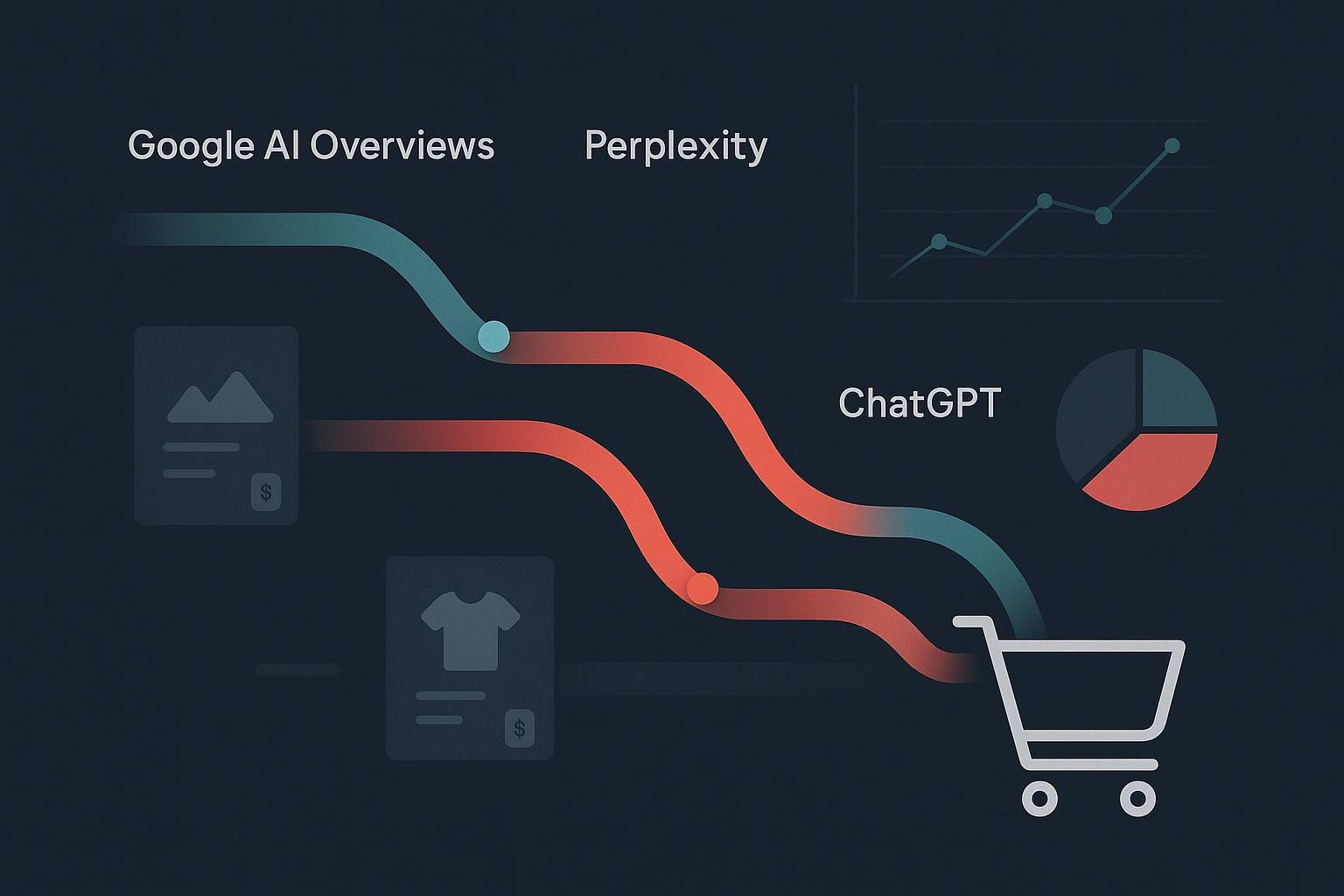
AI answers now shape how shoppers discover, compare, and decide. When Google’s AI Overviews appear, organic results can lose around a third of clicks; Ahrefs’ 2025 studies estimate average losses near 34.5% when an AI Overview shows, and many high-volume queries surface AI summaries far more often than you might expect. Semrush’s July 2025 analysis adds useful context: while fewer users click through, certain cohorts of AI-search visitors convert at roughly 4.4x higher value. Net-net, the buyer journey hasn’t disappeared—it’s been rerouted through AI surfaces.
What the AI‑search journey looks like now
Shoppers use AI to shortcut research, especially for comparative queries (best X for Y, A vs. B). Google’s guidance emphasizes people‑first content and technical readiness for AI features, with citations drawn from credible sources. If you want consistent inclusion, the fundamentals still matter—indexability, schema parity, feed health, authoritative buying guides. See Google’s AI features and publisher guidance and their helpful content Q&A for AI experiences.
| Funnel stage | AI surface | Signals to track |
|---|---|---|
| Awareness | Google AI Overviews / AI Mode | Presence for head queries; citation count; link prominence; sentiment; overlap with top‑10 organic sources |
| Awareness | Perplexity answers | Inclusion for comparative prompts; numbered citation position; topic clustering |
| Consideration | ChatGPT (with browsing/integrations) | Whether your brand/product is recommended; source lineage; prompt patterns that trigger inclusion |
| Consideration | Traditional SERPs + review sites | Blended experience with AI; review schema health; third‑party authority |
| Conversion | PDP/PLP + on‑site search | Content parity with structured data; attribute richness; internal search outcomes |
| Post‑purchase | Help/returns + UGC | Accuracy in AI answers; updated policies; community sentiment |
Build the touchpoint map: a practical workflow
-
Define scenarios and queries Capture real intents: budget constraints (under $200), persona attributes (for runners with flat feet), localization (UK vs. US). Compile head and long‑tail prompts per market. Include brand, generic, and competitor comparisons.
-
Capture AI surface signals Instrument daily or weekly crawls for Google AI Overviews/AI Mode, Perplexity, and ChatGPT. Log: inclusion yes/no, citation positions, prominence, sentiment, and query class. Keep snapshots—static screenshots decay quickly; you need time series.
-
Normalize into analytics Route inclusion events into GA4/CDP with clean taxonomies: platform, query class, locale, device. Treat them like campaign touchpoints so assisted conversions are measurable alongside commerce data.
-
Optimize content and feeds Close gaps identified by your logs. Reinforce entities (brand, product, attributes) with consistent IDs, schema.org/Product, rich media, review schema, and healthy product feeds. Build comparative buying guides that answer attribute‑rich questions (best waterproof hiking jacket under $150; breathability vs. durability trade‑offs). Google’s guidance on AI features underscores quality and relevancy; see Using generative AI content—publisher notes.
-
Attribution and testing Run pre/post content upgrades targeting AI inclusion. Use geo‑split tests where feasible. Read assisted conversions in GA4 and watch brand search lifts after inclusion changes. Where data sharing permits, use clean‑room joins to reconcile modeled AI exposure with platform conversions; IAB’s privacy playbooks and clean‑room guidance are table stakes—see IAB guidelines on AI and privacy‑preserving tech.
-
Governance and QA Establish AI content review, provenance tagging, and periodic audits. Align processes to NIST’s AI Risk Management Framework and ISO/IEC AI standards for oversight and documentation—see NIST AI RMF and ISO/IEC 42005 overview.
Disclosure: Geneo (Agency) is our product.
Example tool fit (practitioner note, non‑promotional): In a weekly workflow, we’ve used a white‑label AI visibility tracker to log brand mentions across Google AI Overviews, Perplexity, and ChatGPT, stream them into a dashboard as AI share‑of‑voice, and export client‑ready reports. A platform like Geneo (Agency) can serve this role within an agency stack when you need branded portals and daily inclusion history.
Instrumentation and KPIs that matter
Visibility KPIs
- AI share of voice within defined query sets
- AI mentions and total citations by platform
- Platform breakdown and prominence (where the citation sits; sentiment indicators)
Journey and performance KPIs
- Assisted conversions attributed to AI‑influenced sessions (proxy events + DDA)
- Brand search lift and direct traffic deltas following inclusion changes
- Content‑level ROI: revenue and conversion rate shifts for pages that gain inclusion vs. controls
Dashboard design cues
- Separate boards by stage: discovery (inclusion), consideration (comparative answer presence), conversion (assisted conversions). Use time‑series trends and localization slices. Show experiment tags (pre/post), and annotate major model changes or site releases.
Attribution that holds up in 2026
Google Analytics 4’s data‑driven attribution (DDA) remains the standard. Ensure conversion events and windows are consistent, then evaluate assisted contributions alongside last‑click comfort metrics. GA4’s documentation on DDA and assisted conversions is a solid reference—see GA4 data‑driven attribution overview and assisted conversions guidance.
Because AI assistants influence research early, stitch evidence from multiple angles:
- Experiment reads: pre/post inclusion changes; geo‑split pilots.
- Proxy signals: appearance frequency on AI surfaces; sentiment; prominence.
- Outcome lifts: branded queries, direct sessions, and assisted conversions.
As AI agents move closer to executing purchases, last‑click alone breaks down. McKinsey frames this shift and the need for multi‑source models (MTA + MMM hybrids and incrementality)—see McKinsey on winning in the age of AI search (2025). In practice, reserve last‑click for sanity checks; let DDA carry the day, and use MMM or clean‑room joins to validate material changes.
Operational cadence for agency teams
Weekly
- Scan inclusion across AI surfaces; flag inaccuracies or brand‑unsafe answers.
- Log deltas by query class and locale; open sprint tickets for gaps.
Monthly
- Review visibility KPIs and assisted conversions; compare experiment cohorts.
- Refresh buying guides and PDP attributes based on common comparative prompts.
- Assess localization variance; update images, pricing, and availability.
Quarterly
- Recalibrate attribution (MMM/MTA updates), review privacy and governance controls.
- Audit provenance and documentation; archive model version influences.
- Refresh the touchpoint map with new surfaces (voice, multimodal) and connector changes.
Mini case snapshot: reading results from a retail program
A mid‑market apparel brand aimed to win “best rain jacket under $150” across AI surfaces in the US and UK. We compiled 120 prompts (generic, brand, competitor), captured daily inclusion signals, and normalized them into GA4.
- Within six weeks, comparative buying guides and PDP attribute fixes drove inclusion for 38% of target prompts on Google AI Overviews and 29% on Perplexity. ChatGPT recommendations appeared consistently when prompts referenced breathability ratings.
- Assisted conversions for sessions exposed to included prompts rose ~14% in the US (DDA), with brand search increasing ~11% week‑over‑week during peak inclusion. UK effects lagged until localization updated images and availability.
- Geo‑split test indicated a statistically significant lift versus control locales, validating that inclusion changes aligned with downstream outcomes. Screenshots alone would have missed the time‑series nuance; normalized events told the fuller story.
Governance and QA: make it durable
- Provenance: Tag AI‑generated assets with metadata; document model versions and prompt patterns that influence public answers.
- Review gates: Human‑in‑the‑loop verification for product comparisons and safety‑sensitive content.
- Audits: Quarterly checks against NIST/ISO/IAB controls; remediate drift (outdated specs, incorrect claims).
- Risk hygiene: Maintain opt‑out controls (nosnippet/noindex where appropriate), align Merchant Center and Business Profile data, and keep review schema clean. Google’s guidance on AI features and citations reinforces the importance of trustworthy sources—see AI features and your website.
Strategic next steps
- Stand up a unified AI‑visibility logging process within your analytics stack.
- Prioritize attribute‑rich buying guides and PDP parity with structured data.
- Adopt DDA with experiment discipline; validate lifts with clean‑room or MMM support where feasible.
- Formalize governance: provenance, audits, and localization workflows.
If you’re leading an e‑commerce program, the question worth asking this quarter is: Which comparative prompts, by market, should our brand own—and how will we prove their influence on revenue without relying on screenshots?