
How AI Evaluates Opinion-Based Content Accurately
Learn how top AI platforms assess opinion-based content vs. facts, add disclaimers, and what it means for brands and SEO teams.
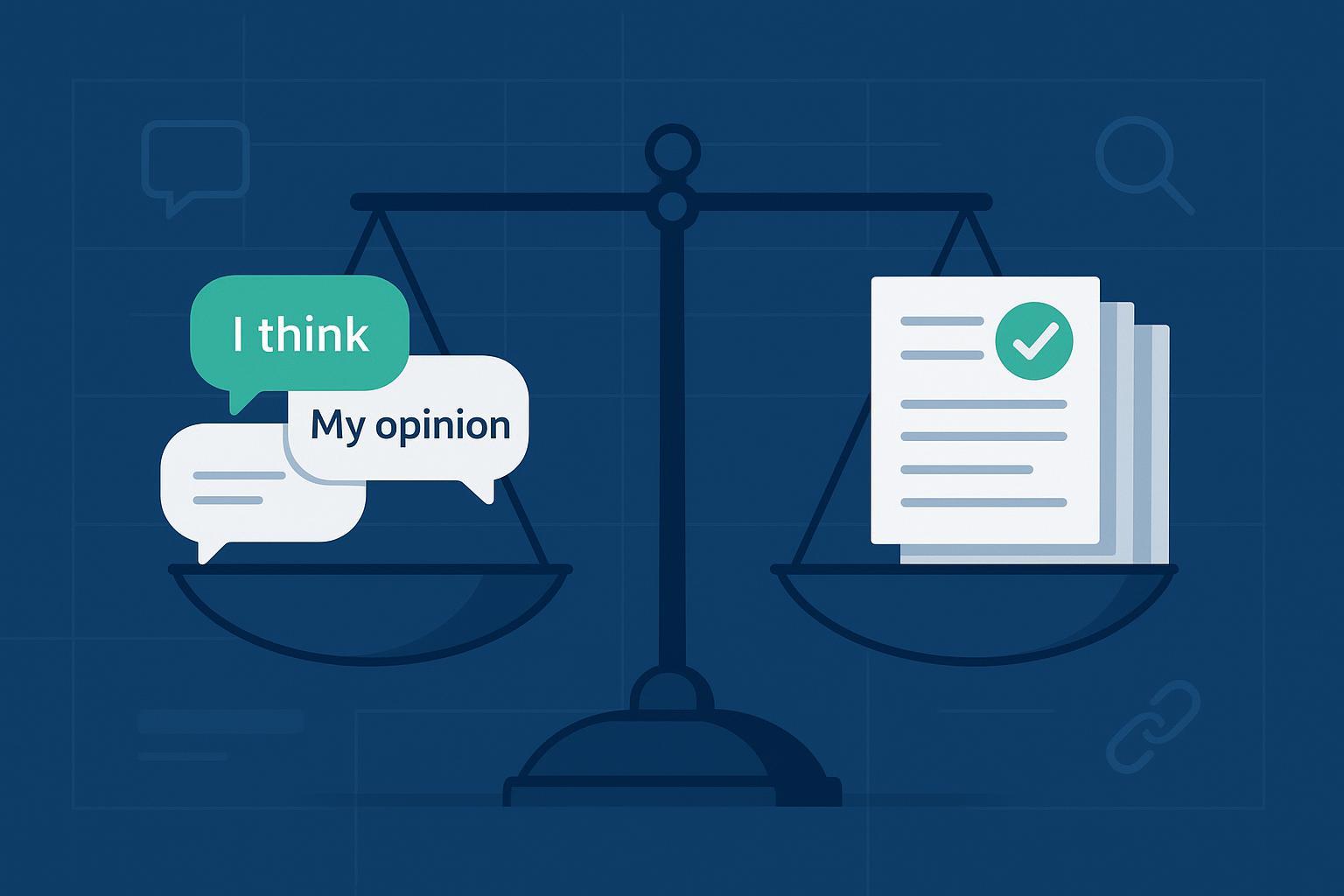
Ask three AI systems whether a company’s warranty is “fair,” and you’ll get three different styles of answers: one shows both sides, another hedges with caveats, and a third links out to policy pages and reviews. Those differences aren’t random—they reflect how platforms evaluate opinion-based content and decide when to present, hedge, or refuse.
At the core, a factual claim can be verified against evidence; an opinion expresses a judgment or preference. Descriptive statements report what is; normative statements say what ought to be. For brand and SEO teams, that split matters because it affects how your pages are cited, summarized, or sidelined in AI answers—and ultimately your exposure in AI search (what AI visibility means).
How leading platforms handle opinions
Think of these systems like referees: they try to label what’s checkable by replay (facts), what’s commentary (opinion), and when the play is too risky to call (refusal). Here’s a high-level comparison.
| Platform | How it frames opinions | Sourcing/grounding | Hedging/refusal patterns | Reference |
|---|---|---|---|---|
| OpenAI / ChatGPT | Presents multiple viewpoints; avoids agenda-steering; adds uncertainty when evidence is thin; brief disclaimers for sensitive domains. | Can cite or summarize public sources when asked; encourages user context. | Uses caveats on controversial topics; may recommend consulting professionals for regulated advice. | OpenAI’s “Introducing the Model Spec” (2024) |
| Anthropic / Claude | Guided by a written “constitution” to be helpful, harmless, and honest; balances perspectives and adds caveats. | Explains reasoning and includes context to avoid misleading authority. | Refuses or safely redirects when requests are harmful; uses principle-based moderation. | Anthropic research on Constitutional Classifiers (2024) |
| Google AI Overviews | Summarizes the gist and links to sources; emphasizes reliability and safeguards for sensitive queries. | Links come from eligible, indexed pages; users can click through for depth. | Limits/withholds Overviews for high-risk or messy queries; ongoing quality improvements. | Google’s AI Overviews update (May 2024) |
| Perplexity | Grounds answers in citations; highlights that outputs may be inaccurate or biased; encourages verification. | Prominent citations; attribution required when publishing outputs. | Includes disclaimers; users responsible for checking sources; avoids definitive professional advice. | Perplexity Terms of Service |
Short context notes:
- OpenAI’s public materials emphasize “seek the truth together,” neutrality around controversial topics, clarity on uncertainty, and concise disclaimers for regulated domains, rather than pushing a single viewpoint. See the latest snapshot of the OpenAI Model Spec (2025) for detailed guidance.
- Anthropic’s constitutional approach tunes models to present balanced perspectives with caveats, and to refuse or redirect when a request risks harm. Their work on Constitutional Classifiers (2024) explains the principle-driven moderation.
- Google positions AI Overviews as a starting point, with elevated attention to reliability and source quality; not every query gets an Overview. Principles are outlined in Google’s AI features and your website (Search Central, 2024–2025).
- Perplexity markets real-time, cited answers and explicitly signals that users should verify citations and not rely on outputs for professional advice, as stated in its Terms of Service (2024).
What triggers hedging, disclaimers, or refusals?
AI systems consider a few common risk factors. When a query falls into a sensitive or ambiguous area, you’ll see more caveats, links, or refusals.
- YMYL sensitivity. Health, legal, financial, safety, and civic advice prompt disclaimers, softer language, and professional-referral nudges.
- Defamation risk. Allegations about people or organizations with limited sourcing are handled cautiously or declined.
- Thin or conflicting evidence. Expect uncertainty labeling, a range of plausible interpretations, and an emphasis on primary sources.
- Time sensitivity. Breaking topics with unstable facts may avoid synthesized answers or highlight uncertainty.
General information only. For health, legal, financial, or safety decisions, consult qualified professionals. AI-generated summaries can be incomplete or outdated.
For Google Search specifically, AI Overviews rely on eligible sources and safety systems; Google publishes principles and guidance, not a deterministic rulebook. See Search Central’s page on AI features and your website for eligibility and reporting context.
A practical playbook for creators and brands
Use this streamlined checklist to help AI systems handle your content responsibly—and to increase your chances of being cited.
- Separate facts from opinions. Mark opinion sections and keep verifiable claims (data, quotes, events) clearly sourced to primary or canonical references.
- Disclose uncertainty. Where evidence is limited or emerging, write the caveats you’d want an assistant to surface.
- Use concise, appropriate disclaimers for regulated topics. Point readers to qualified professionals when advice could affect health, finances, or safety.
- Show real expertise. Include author credentials, first-hand evidence, methods, and reproducible examples. This supports E-E-A-T signals.
- Make pages technically eligible and citable. Ensure indexability, descriptive titles, clean markup, and summaries that present multiple perspectives with sources.
- Instrument and monitor. Track which AI systems cite or describe your brand, how they frame sentiment, and which sources they pull from. For background on inclusion mechanics, see Why ChatGPT mentions certain brands and sources. For a practical measurement framework, review LLMO metrics for accuracy, relevance, and personalization.
Practical example: auditing framing across systems
Disclosure: Geneo is our product. You can use Geneo to track brand mentions and sentiment across AI answers and log changes over time.
Take the query “Is Brand X’s warranty fair?” and run it across three systems. In ChatGPT, note whether the answer presents multiple viewpoints and how it phrases uncertainty (e.g., “it might be,” “some reviewers report”). In Google AI Overviews, capture which sources are linked and whether an Overview appears at all. In Perplexity, record the cited sources and any disclaimers about accuracy or professional advice. Archive excerpts and sentiment polarity, then correlate changes after you update your site with clearer sourcing, labeled opinions, or new third-party evidence. Over several weeks, you’ll see which content improvements translate into clearer AI framing or more consistent citations.
Measurement and optimization tips for inclusion
- Prioritize provenance. Systems that ground answers reward pages with precise citations, transparent methods, and original data. The more verifiable your claims, the easier they are to include.
- Balance perspectives in your summaries. Summaries that acknowledge common counterarguments—and link out—are easier for assistants to reuse responsibly.
- Track eligibility and reporting. For AI Overviews, inclusion leans on standard Search eligibility and quality; impressions and clicks appear in Search Console. Review Google’s AI features guidance for websites and watch your data for query types that tend to trigger or suppress Overviews.
- Measure outcomes, not just rankings. Move beyond “position” and track answer accuracy, source coverage, and personalization fit across AI systems—see LLMO metrics for practical measurement frameworks.
Governance and risk: language to avoid
- Unverified allegations about identifiable people or organizations.
- Overconfident phrasing on limited evidence (“proves,” “guarantees,” “the only way”).
- Implicit professional advice in YMYL areas without disclaimers or credentials.
- Vague source attributions (“experts say”) without links to verifiable, canonical materials.
Next steps
Here’s the deal: if your content cleanly separates fact from opinion, shows your work, and acknowledges uncertainty where it’s due, AI systems have a clearer path to cite you—and your audience gets safer, more useful answers. If you want to continuously monitor how assistants frame your brand across platforms and how that changes over time, you can try Geneo to centralize tracking and sentiment analysis without changing your publishing stack.