14 Best Tools for AI Brand Reputation Tracking in 2025
Discover 14 top tools for AI brand reputation tracking in 2025. Compare solutions for search engines, social, news, and reviews. Stay ahead—read now!
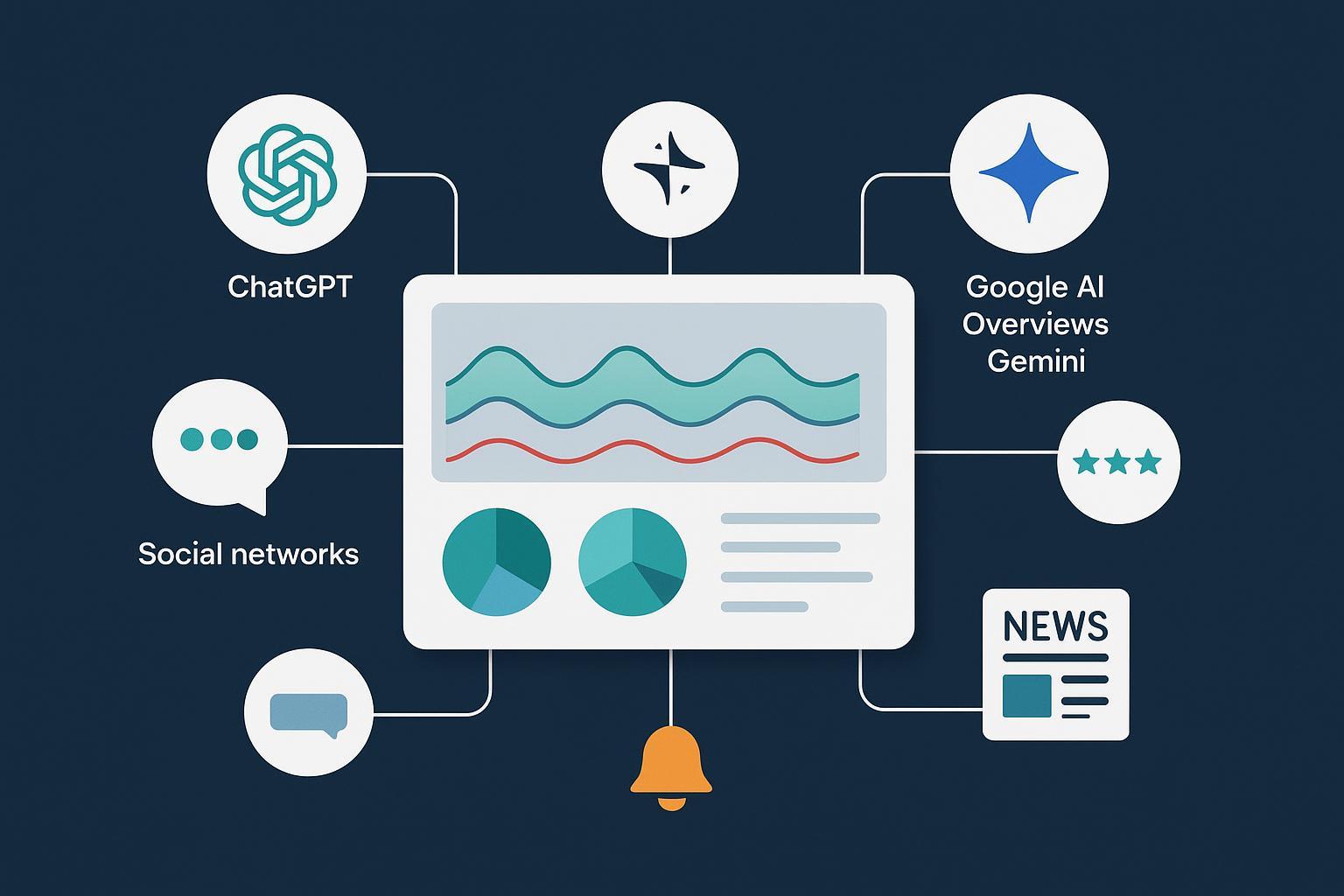
If your brand is judged by what AI answers and social conversations show, you need visibility far beyond classic SEO. AI visibility—how your brand appears in answers from engines like ChatGPT, Perplexity, and Google’s AI Overviews—now shapes perception alongside social, news, and reviews. For a quick primer on definitions and KPIs, see the explanation of AI visibility and our measurement guide on AI search KPI frameworks.
Below is a practical, neutral rundown of tools that help teams track and improve reputation across AI search surfaces and traditional channels. Prices and engine coverage shift often—treat everything here as subject to change and verify details with vendors.
| Tool | Channels/Engines (examples) | Sentiment | Citation visibility | Alerts | Reporting/Exports | Starting price (indicative) | Best for |
|---|---|---|---|---|---|---|---|
| Profound | ChatGPT, Perplexity, Google AI Overviews | Yes | Yes | Yes | CSV, APIs | Custom/enterprise | Enterprise AI visibility and SOV |
| Keyword.com AI Visibility | Google AI Overviews, Perplexity, ChatGPT | Yes | Yes | Yes | Dashboards, Looker | From ~$24.50/mo | SMB–mid-market teams tracking prompts |
| Surfer AI Tracker | Google AI Mode, Perplexity, ChatGPT | Yes | Yes | Yes | Shareable reports | In-plan/add-on | Content-led optimization workflows |
| Yoast AI Brand Insights | ChatGPT, Perplexity | Yes | Yes | Weekly | Web-based exports | Bundled in Yoast AI+ | Bloggers/SMBs, quick diagnostics |
| ZipTie.dev | Google AI Overviews, ChatGPT, Perplexity | Yes | Yes | Yes | Full response exports | From ~$69/mo | Practical monitoring at volume |
| BrandRank.ai | ChatGPT, Google/Gemini, Claude (verify locales) | Yes | Yes | Yes | Benchmarks | Custom/enterprise | Trust scoring and risk detection |
| Geneo | ChatGPT, Perplexity, Google AI Overview | Yes | Yes | Yes | Multi-brand workspaces | Free tier + plans | Cross-engine tracking for brands/agencies |
| Brand24 | Social, news, blogs, podcasts | Emotion-level | N/A | Yes | API/exports | Tiered pricing | Real-time social/news monitoring |
| Meltwater | Social, news, broadcast, LLMs (GenAI Lens) | Yes | Yes | Yes | Enterprise dashboards | Custom/enterprise | Large-scale media intelligence |
| Podium | Reviews/local (Google, Facebook, etc.) | Yes | N/A | Yes | Team workflows | Tiered pricing | Storefronts/local services |
AI search/answer engine trackers
Profound positions itself as an enterprise AI visibility platform that monitors the answers users actually see across ChatGPT, Perplexity, and Google AI Overviews/AI Mode. It emphasizes share of voice, citation authority, and multi-region tracking, with exports and API/BigQuery options for deeper analysis. According to the company’s feature overview and recent product updates, coverage centers on consumer-facing AI search experiences rather than raw API output, with frequent notes about Google’s AI Mode behavior. See Profound’s product and blog materials for details, including the discussion of AI Mode’s trajectory in “Google AI Mode Confirms Chat Is The Future Of Search” (2025). Pricing is enterprise and typically custom; confirm engine lists and locales directly with sales.
Keyword.com’s AI Visibility tracker focuses on prompt-level monitoring and brand mentions across Google AI Overviews, Perplexity, and ChatGPT, with dashboards, alerts, white‑label reporting, and Looker integrations. The company’s public pricing shows entry tiers with credit-based runs and scheduling options; as of late 2025, the AI visibility page outlines coverage and workflows. For current capabilities and pricing, consult Keyword.com’s AI Search Visibility page.
Surfer’s AI Tracker brings daily monitoring for Google AI Mode/Overviews, Perplexity, and ChatGPT, and ties insights directly into its content optimization stack (Content Editor, Facts, Coverage Booster). Teams use it to spot rank drops, compare competitors, and address citation gaps with actionable content updates. Surfer publishes rolling product updates that confirm AI Tracker enhancements and coverage; see the October roundup for the latest additions: “What’s New at Surfer — October 2025”.
Yoast AI Brand Insights is a browser-based tool (not a WordPress plugin) that scans visibility in ChatGPT and Perplexity, analyzes sentiment and citations, and provides weekly reporting with competitor comparisons. It’s packaged within Yoast SEO AI+, making it a simple option for bloggers and smaller teams who want quick diagnostics without changing their CMS. The December 3, 2025 announcement confirms Perplexity support and outlines core features: “New to AI Brand Insights”.
ZipTie.dev monitors Google AI Overviews, ChatGPT, and Perplexity, and is known for practical workflows: manage queries (manual or imported), track full response texts, benchmark competitors, and use its “AI Success Score” and Insights tab to prioritize fixes. If you need volume-friendly monitoring with transparent exports, this one is easy to operationalize. Public pricing tiers are updated regularly; check the site’s pricing page and feature posts, such as “ZipTie tracks AI Overviews, ChatGPT and Perplexity”.
BrandRank.ai offers AI visibility and trust scoring across engines like ChatGPT, Google/Gemini, and Claude, with benchmarking and vulnerability detection. It’s positioned for enterprise use cases that care about narrative risk and trust signals in generative answers. Pricing is custom; locales and engine depth should be confirmed during discovery, as coverage evolves quickly.
Geneo monitors brand presence across ChatGPT, Perplexity, and Google AI Overview with sentiment analysis, historical tracking, competitor benchmarking, alerts, and multi-brand workspaces designed for teams and agencies. Disclosure: Geneo is our product. If you run multiple brands or need client-ready reporting, Geneo’s cross-engine view and white‑label exports help consolidate workflows while keeping the focus on measurable outcomes.
Social/news media intelligence suites
Talkwalker is a long-standing enterprise suite covering social, news, forums, and reviews, backed by computer vision and multilingual sentiment. Teams use it for crisis detection, executive reporting, and global monitoring at scale, typically via custom contracts and data add‑ons. It’s a reliable choice for organizations that need broad coverage, robust alerting, and integrations into BI.
Brand24 serves SMB–mid‑market teams with real-time monitoring across social, news, blogs, forums, podcasts, and reviews, and adds AI anomaly detection with emotion-level sentiment. It’s strong on ease of setup, actionable alerts, and exports/API for teams that want quick wins without enterprise overhead. For an overview of AI features and anomaly detection, see the vendor’s page on Brand24 AI solutions.
Truescope takes an AI‑first approach to media intelligence with assistants for reporting, search, and monitoring, plus crisis workflows and configurable alerts. It spans online news, broadcast, podcasts, and social, and offers branded newsletters and KPI dashboards, making it suitable for comms teams that need a guided, collaborative environment.
Meltwater covers social, news, broadcast, and more, and in late 2025 introduced GenAI Lens to monitor how large language models represent your brand across engines like ChatGPT, Claude, Gemini, Perplexity, and others. Combined with predictive analytics and its Mira AI teammate, it appeals to enterprises that want unified intelligence with LLM monitoring built into the stack. See Meltwater’s year‑end product release for details: “Smarter Media Intelligence with New AI Innovations” (2025).
Brandwatch provides AI‑powered consumer intelligence across 100M+ sources, extensive historical data, and Iris AI for alerts, peak detection, and generative summaries. It’s well‑suited to teams that need research‑grade breadth and integrations, with the caveat that plan configuration matters for access to certain sources or features.
YouScan leads in visual social listening, detecting logos, products, scenes, and visual sentiment across social/web. If imagery and video drive your brand narratives, YouScan’s visual insights and real‑time alerts can surface reputation shifts that text-only tools miss.
Reviews and local reputation
Podium focuses on reviews and local reputation for storefronts and services. It aggregates reviews from platforms like Google and Facebook, adds AI‑assisted replies and sentiment, and pairs monitoring with two‑way messaging and team workflows. If your reputation is heavily influenced by local search and customer service response time, Podium helps close the loop between listening and action.
How we chose
We compared tools using five criteria designed for marketing and comms teams:
- AI engine or channel breadth (25%): Which AI search surfaces or media sources are covered, and in which locales.
- Capability depth (30%): Sentiment, share of voice, citation visibility, alerts, and reporting.
- Evidence quality and recency (15%): Vendor documentation and authoritative updates in 2024–2025.
- Usability and integrations (15%): Slack/email alerts, exports/APIs, dashboards, and collaboration.
- Value and pricing transparency (15%): Clear “from” pricing or quote flows for realistic budgeting.
For measurement guidance (visibility, sentiment, conversion proxies), we recommend our AI search KPI frameworks article on Geneo’s blog. We prioritized canonical vendor pages and major product announcements for factual claims, including Profound’s AI Mode notes, Keyword.com’s AI visibility overview, Surfer’s AI Tracker updates, Yoast’s AI Brand Insights announcement, ZipTie’s coverage blog, Meltwater’s GenAI Lens release, and Brand24’s AI features page.
What’s next in AI brand tracking
AI engines change fast. Google’s AI Mode and Overviews continue to shift the search experience; ChatGPT Search, Perplexity updates, and new entrants affect coverage and citation patterns. Two practical implications follow. First, visibility tracking must stay current: re‑run priority prompts often and confirm locales. Second, workflows should tie monitoring to fixes—content, citations, and reputation guardrails—so you’re not merely watching declines but preventing them. As agent ecosystems and compliance requirements evolve, look for tools that log answer history, expose citation quality, and integrate with your reporting stack.
If you manage multiple brands or clients, you’ll want standardized processes and exports. Agencies in particular benefit from multi‑brand workspaces, white‑label reporting, and alert routing; you can explore a consolidated workflow on our Geneo for Agencies page.
Final thoughts
There’s no single platform that perfectly covers every AI engine and media source worldwide, and that’s okay. Choose one primary AI visibility tracker and one social/news suite, then add reviews/local monitoring if it materially influences your reputation or revenue. Keep your criteria tight, your prompts realistic, and your evidence auditable. And when features evolve—as they inevitably do—update your monitoring set so your brand is judged by current answers, not last quarter’s snapshots.