
AI-Based Product Claim Validation Explained for Marketers
Learn how AI validates product claims with evidence, supports substantiation, and reduces risk. Plain-language steps with compliance guidance for marketers.
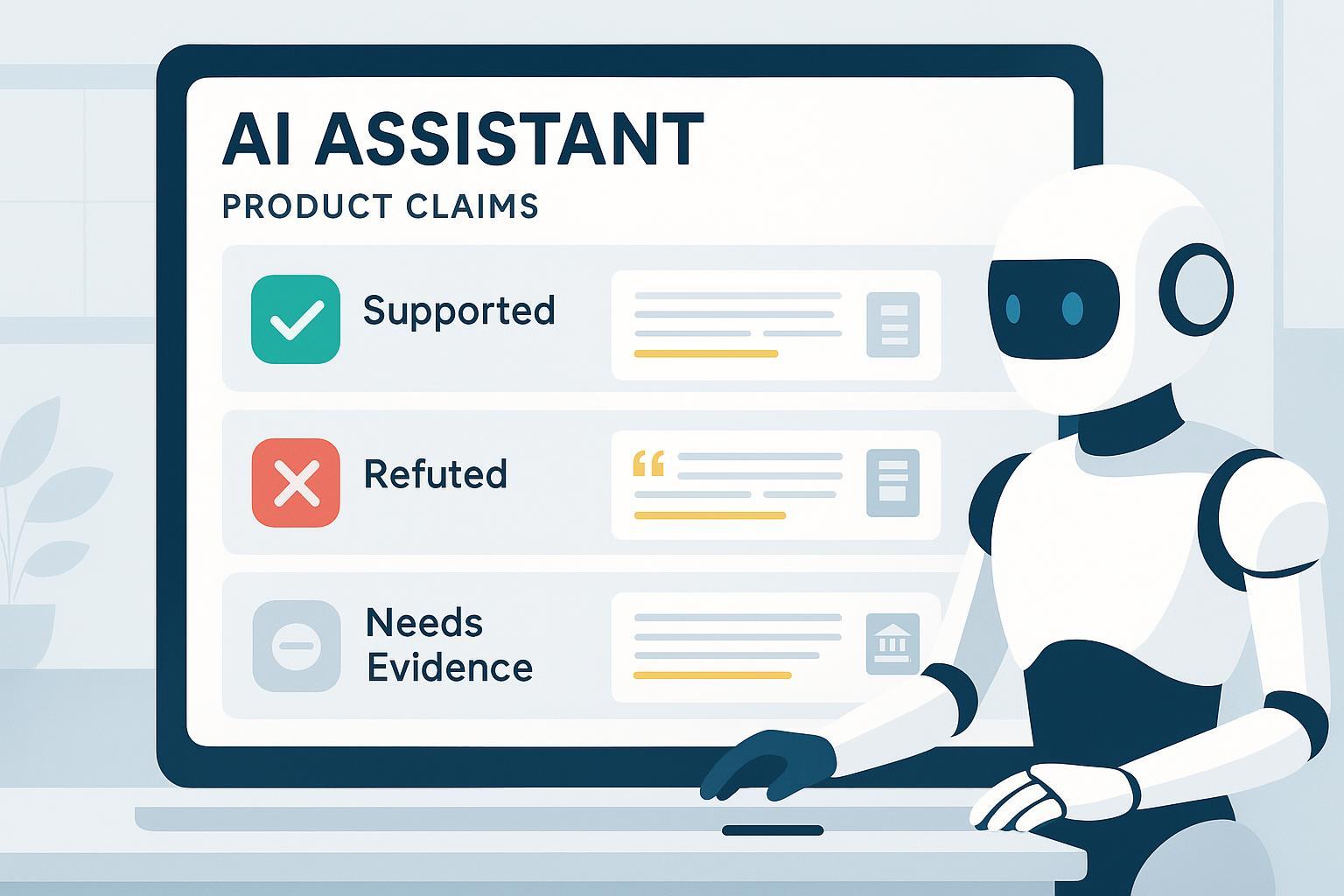
Are your product claims ready for both regulators and AI answer engines? Here’s the deal: “AI-based product claim validation” means using AI to gather, assess, and document evidence so your marketing statements are truthful, non-misleading, and backed by proof before they go live.
What “substantiation” means in plain English
In the United States, the Federal Trade Commission (FTC) expects prior substantiation—advertisers must have a reasonable basis for objective claims before they’re made. The agency’s plain-language hub explains these responsibilities in its FTC Advertising and Marketing guidance. For higher‑risk domains like health, the FTC’s resource on the Health Products Compliance Guidance clarifies what counts as “competent and reliable scientific evidence,” often including well‑controlled human clinical trials where appropriate; see the FTC Health Products Compliance Guidance resource page.
Endorsements and testimonials don’t replace evidence. The FTC’s 2023 revision to its Endorsements Guides requires clear, conspicuous disclosures of material connections and makes it clear that claims presented through influencers still need substantiation. For details, see the Federal Register notice for the 2023 Endorsements Guides update.
How AI actually checks a claim
Think of an AI validator like a careful librarian. It doesn’t “decide” truth on its own—it retrieves authoritative sources, highlights the passages that matter, and then issues a verdict that ties back to those passages.
- Retrieval + RAG (Retrieval‑Augmented Generation): The system first searches a curated corpus for likely evidence, then asks a model to assess the claim using those sources as context. This grounding reduces hallucinations and creates an explainable chain from claim to citations. A 2024 survey of claim‑verification pipelines describes this pattern across stages like retrieval, rationale selection, and veracity prediction; see “Claim Verification in the Age of Large Language Models” (2024 survey).
- Verdicts you can act on: Most systems classify each claim as Supported, Refuted, or Not Enough Info. That third option (abstention) is a safety feature—if the evidence isn’t good enough, the tool should say so rather than guess.
- Evidence‑aware evaluation: It’s not just about labeling; it’s about showing your work. The FEVER benchmark (2018) popularized a joint score that rewards systems for both the correct verdict and the specific evidence that supports it. For background, see the FEVER dataset introduction (2018).
Evidence expectations by claim type
Below is a quick, non‑exhaustive reference. Your legal and scientific standards may vary by jurisdiction and industry.
| Claim type | Typical evidence to prepare | Risk level | Human expert review needed? |
|---|---|---|---|
| Performance (“improves load time by 20%”) | Controlled tests, reproducible methodology, independent replication where possible | Medium | Recommended for methodology and stats checks |
| Cost or efficiency savings (“cuts costs by 15%”) | Documented before/after data, clear assumptions, time frames, sample sizes | Medium | Recommended for assumptions and sample bias |
| Health/efficacy (“reduces joint pain”) | Human clinical trials where appropriate, peer‑reviewed studies aligned to claim wording | High (YMYL) | Yes; specialist review and strict standards |
| Environmental (“lower carbon footprint”) | Life‑cycle assessments, standards‑based measurements, third‑party certifications | High | Yes; domain expert and standards alignment |
A simple, auditable workflow you can adopt
You don’t need a research lab to start. Here’s a practical flow marketers and compliance teams can run together.
-
Define the claim precisely. Write it in objective, measurable terms and consider the “net impression” a typical consumer would take away. The FTC Advertising and Marketing guidance outlines why your basis must exist before dissemination.
-
Build a curated evidence corpus. Prioritize authoritative sources: regulator pages, standards bodies, peer‑reviewed literature, and your own official documentation. For context on choosing sources that actually get surfaced in AI answers, see our primer on AI visibility and how answer engines cite content.
-
Retrieve evidence, then verify with RAG. Use hybrid retrieval (keyword + semantic) to collect candidate passages, then run a grounded assessment to produce a verdict (Supported/Refuted/Not Enough Info) with citations. The 2024 claim‑verification survey offers a good overview of these steps.
-
Measure verification quality. Don’t just accept a label—inspect the evidence. Track retrieval precision/recall, a FEVER‑style joint score (correct label + correct evidence), and the rate of safe abstentions. We’ve outlined practical ways to turn these into KPIs in LLMO Metrics: accuracy, relevance, and groundedness for AI answers.
-
Document provenance for auditability. Record how each verdict was produced: sources used, who reviewed, parameters, and timestamps. The W3C’s PROV‑O vocabulary offers a standard way to describe Entities (claims and sources), Activities (validation steps), and Agents (people/systems); see W3C PROV‑O. When you want to publish a public‑facing summary for discovery, the schema.org ClaimReview specification captures the claim, verdict, citations, and reviewer.
-
Add human review where risk demands it. For health, safety, and financial claims (YMYL), involve qualified experts and match the evidence to domain norms. As noted in the FTC’s health guidance resource, “competent and reliable scientific evidence” can mean well‑controlled human trials for certain claims; align your standards to the specific claim language.
-
Maintain and re‑validate. Evidence evolves. Store your validation files, set a re‑review cadence, and track changes to claims, sources, and models. Build a lightweight change log so anyone can see what changed and why.
What AI does well—and where humans must decide
- AI accelerates evidence discovery, highlights relevant passages, and flags gaps where more proof is needed.
- It can monitor consistency across channels, helping you keep claims aligned from the website to sales decks to AI answer engines.
- But AI shouldn’t overrule domain expertise. In YMYL areas, human specialists must interpret study design, statistical power, clinical relevance, and real‑world applicability.
Practical example (disclosed)
Disclosure: Geneo is our product. Suppose your site claims “reduces response time by 20%.” You can monitor AI answer engines to see whether they cite your documentation or rely on third‑party sources. A cross‑engine comparison helps you spot gaps—where your claim appears without citations or points to non‑authoritative pages. For a landscape view of platforms, see our comparison of ChatGPT, Perplexity, Gemini, and Bing for monitoring AI answers. If certain engines mention your brand but don’t cite your tests, review our guide on why some brands get mentioned more than others, then improve your corpus and rerun validation.
Common pitfalls to avoid
- Overclaiming or “AI‑washing” (implying capabilities that your evidence doesn’t support).
- Cherry‑picking studies or test runs while ignoring contrary evidence.
- Relying on testimonials or influencer posts without underlying substantiation (remember the FTC’s 2023 Endorsements update and disclosure requirements).
- Forcing a verdict when the evidence is thin—why not treat “Not Enough Info” as a prompt to run better tests?
Build your audit trail and keep it fresh
Treat your validation system like a product. Publish a brief “model card” for any verifier you use: intended use, data sources, evaluation metrics, limitations, version history, and monitoring plans. Store provenance (who did what, when, and with which sources) using a standard like W3C PROV‑O, archive the citations, and set reminders for re‑validation. When appropriate, create a public ClaimReview page so partners and journalists can see a concise, machine‑readable summary.
Get started today
Pick a single claim that matters. Write it precisely, assemble your best evidence, and run an AI‑assisted check with clear citations. Add a quick human review for risk, log the decision, and schedule a re‑check. One clean substantiation file beats a dozen fuzzy promises—and it’s the fastest way to build trust you can prove.