
How Agencies Can Monetize AI Search Visibility for Clients (2025 Best Practices)
Discover proven 2025 strategies for agencies to monetize AI search visibility. Learn packaging, KPIs, retainer models, and monetization tactics for client growth.
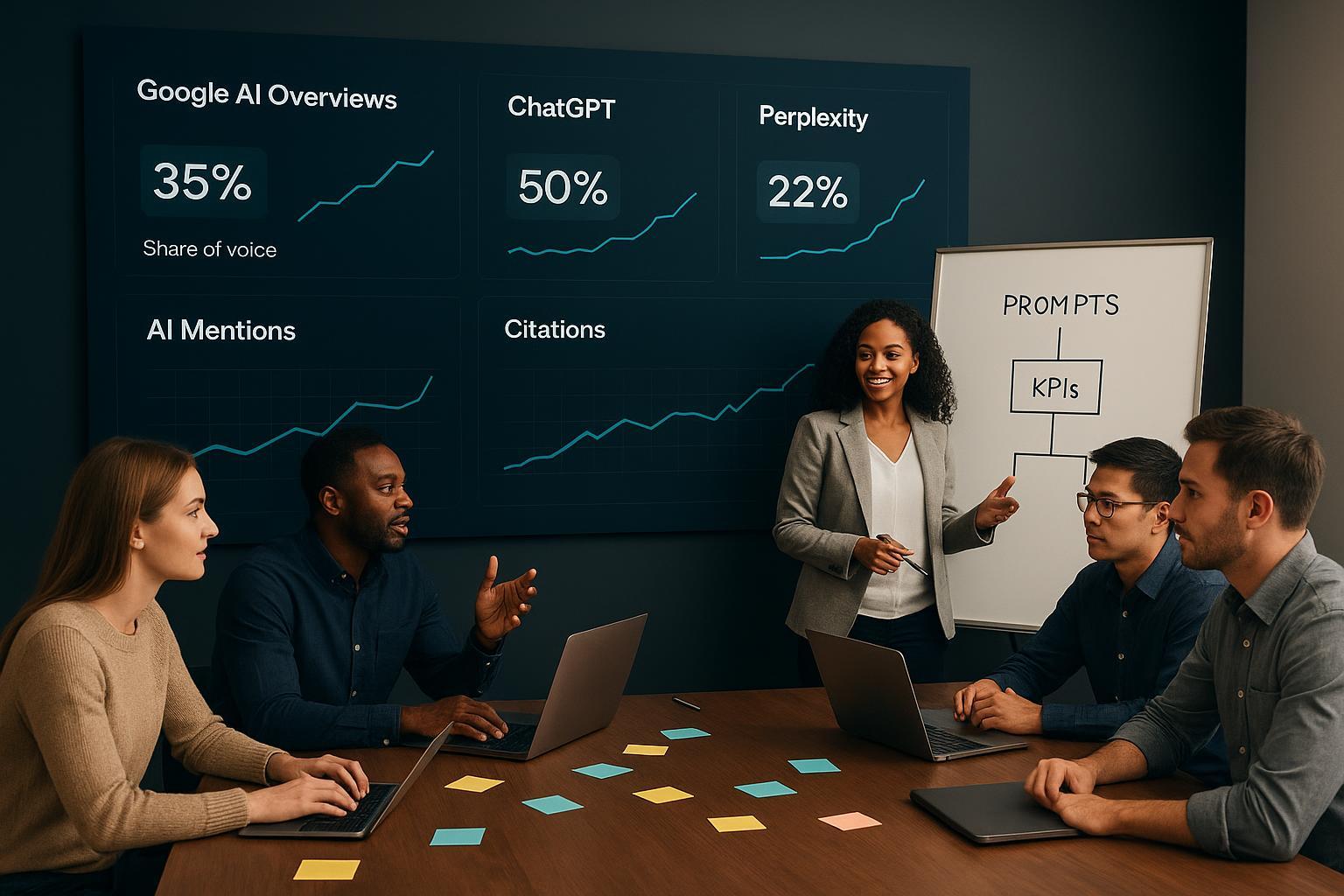
When AI answers reduce clicks, the value shifts from sessions to presence. On queries where Google’s AI Overviews appear, several independent panels found sharp declines in organic and paid CTR; for example, Seer Interactive’s September 2025 update reported organic CTR on AIO queries falling from 1.76% (June 2024) to 0.61% (September 2025), and paid CTR dropping from 19.7% to 6.34 over the same period, as covered by Seer Interactive’s AIO impact study (2025) and Search Engine Land’s summary. Pew’s mid-2025 panel observed that when an AI summary is present, 26% of sessions end with no clicks, and fewer than 1% of users clicked links inside the AI overview, according to Pew Research’s 2025 findings. Agencies must monetize visibility—being cited, recommended, and present—because exposure now happens inside answers as much as it does on landing pages.
Packaging and Pricing Models That Win Retainers
Agencies can productize AI visibility into three core offers and layer on add‑ons. First, an audit aligns entities, schema, and content, sets a baseline across engines, defines prompt libraries, and benchmarks competitors. Second, a monitoring retainer runs weekly or bi‑weekly captures for mentions, citations, and sentiment, pairs those with optimization sprints, and delivers QBR/MBR reporting plus controlled prompt experiments. Third, strategy and enablement cover enterprise governance, cross‑functional training, paid placements planning, and localization or multilingual prompt testing.
Observed ranges and patterns in 2025 suggest GEO/AEO retainers often start around $2,500/month and scale with scope, testing volume, and coverage. Superlines’ practitioner guidance outlines audit + monitoring + strategy packaging and tiered retainers, as discussed in Superlines’ GEO packaging overview (2025). Broader industry pricing guides for SEO services corroborate ranges and retainer dynamics (pilot programs ~$3,600–$5,200; advanced retainers $5,000+), per AgencyAnalytics’ SEO pricing guide (2025). For AI visibility, align price drivers to engines covered (Google AI Overviews, ChatGPT, Perplexity), number of prompts tracked and competitors included, capture frequency and reporting cadence, scope of structured data/entity work, editorial support, paid placements management, and localization modules. Add usage/overage fees for expanded prompt runs, ad hoc studies, or intensive experiments to keep margins healthy while giving clients flexible runway.
KPIs Clients Will Pay For (And How to Report Them)
Clients don’t just want “rankings.” They need transparent, repeatable metrics that reflect their presence in AI answers. A practical KPI set includes AI Share of Voice (the brand’s share of mentions or recommendations across a defined prompt set and competitor cohort), AI Mentions (how often answers mention the brand), Total Citations (how many linked citations to brand content appear and how prominent they are), Primary Source Rate (how often the brand’s own URL is highlighted among citations), Answer Accuracy Rate (the share of answers about the brand that align with approved messaging), and AI‑Influenced Conversion Rate (downstream conversions attributed via surveys, matched‑market tests, and path analysis).
| KPI | What It Measures | Where It’s Most Useful |
|---|---|---|
| AI Share of Voice | Share of mentions/recommendations vs competitors | Executive narrative, QBR trending |
| AI Mentions | Frequency of brand mentions in answers | Weekly optimization sprints |
| Total Citations | Count/inclusion of clickable brand citations | Content/source strategy, provenance |
| Primary Source Rate | Your URL highlighted among citations | Authority reinforcement, link equity |
| Answer Accuracy Rate | Correctness vs approved messaging | Brand safety, PR/QA workflows |
| AI‑Influenced Conversion | Downstream revenue impact | CFO buy‑in, budget defense |
To keep these meaningful, control volatility with consistent prompt libraries and repeated captures, and report medians or ranges when answers fluctuate. Attribute outcomes with mixed methods—combining surveys, matched‑market tests, and tagged journeys—and make the narrative visual with trendlines and per‑engine breakdowns. For deeper practitioner context on KPI definitions and dashboard storytelling, see AI Visibility Ultimate Guide for Marketing Agencies.
A 90‑Day Rollout SOP You Can Execute This Quarter
Days 0–30 focus on audit and baseline: run an entity and schema audit (Organization, LocalBusiness, Product, Article, FAQPage/QAPage), complete content gap analysis, clean up citations and GBP for local brands, capture a baseline across Google AI Overviews, ChatGPT, and Perplexity, define prompt libraries and competitors, and set KPIs, cadence, and governance (editorial standards plus brand QA for answer accuracy).
Days 31–60 turn to implementation and testing: ship structured data updates, publish answer‑first content blocks with question‑led headers and quotable stats, launch review generation and conversational FAQs for local contexts, begin weekly monitoring, and document changes and hypotheses for the next sprint. Controlled experiments across engines should compare prompt phrasing, content formats, and source prominence.
Days 61–90 emphasize optimization and reporting: iterate based on capture data, expand prompt sets, introduce paid placements where appropriate, and build QBR‑ready dashboards and narratives that align next‑quarter objectives and budgets to KPI movement. Wondering if a 90‑day plan can handle volatile AI results? It can—if you control inputs, repeat tests, and narrate ranges rather than single snapshots.
Paid Placements Inside AI Experiences: Where They Fit
Google indicates ads can appear within and around AI Overviews/AI Mode, generally accessed through existing Search and Shopping campaigns, with targeting shaped by conversation context rather than a single query. Trade press summarizing Google’s rollouts noted evolving reporting and the absence of a bid‑only product for AI Overview slots in 2025; see Search Engine Land’s briefings (2025). Microsoft integrates labeled conversational formats into Copilot (e.g., Compare & Decide), with context‑aware targeting via Microsoft Advertising, per Microsoft Advertising’s Copilot updates (2025). Perplexity remains citation‑forward and, as of late 2025, paused new advertiser onboarding while reassessing monetization, according to Adweek’s October 2025 report. Treat paid placements as a complementary module—layer Google/Microsoft where fit, but keep the core value in organic presence, citations, and answer accuracy.
Tooling, Tracking, and Workflow (Brief, Practical Example)
Disclosure: Geneo is our product.
For agencies that need client‑ready visibility reporting without stitching spreadsheets, a white‑label platform can help. A typical workflow is to define prompt libraries per client, run scheduled captures across engines, and publish dashboards that track Share of Voice, AI Mentions, Total Citations, sentiment, and an aggregate visibility score. White‑label client portals and exportable reports make QBRs smoother, while localization modules (country/language simulations) are useful for multi‑market brands. For an overview of agency‑grade KPI models and dashboard examples, see AI Visibility Ultimate Guide for Marketing Agencies and Building a GEO Service Line.
Vertical Modules That Drive Margin
Local SEO programs should prioritize GBP completeness, consistent citations, LocalBusiness schema with geo/serviceArea attributes, conversational FAQs, and review velocity, while monitoring AI Overview visibility and answer accuracy. Practical context from Google’s documentation on how AI features surface links is summarized in Google Developers’ AI features page (2025).
B2B service lines benefit from question‑led content with structured takeaways and unique data, FAQ schema, quotable stats, and distribution across owned and earned channels. Forrester’s 2025 perspective suggests B2B buyers are adopting AI‑powered search faster than consumers; see DigitalCommerce360’s summary of Forrester’s findings (2025).
Ecommerce roadmaps should emphasize Product schema completeness, comparison‑ready content (pros/cons and specs), enriched product feeds, and FAQ content mapped to “best for” and “vs” queries. For topical context on AI comparison modes affecting product discovery, see Optimal’s ecommerce analysis.
QBR Narratives, Renewal Logic, and Pricing Scenarios
Your quarterly business review should tell a visibility story that balances numbers with context. Start with momentum: show AI SoV and citation trendlines, and highlight platform breakdowns. Address quality and safety by reporting Answer Accuracy Rate and primary source inclusion, noting where brand content was cited and where provenance improved. Maintain an experiment ledger that documents prompts tested, hypotheses, and outcomes, and flag next‑quarter tests and expected investment. Close the loop on attribution with AI‑influenced conversion signals from surveys, matched‑market tests, and path analysis.
Pricing scenarios that land with CFOs and CMOs often follow a sequence. A pilot bundles a fixed‑scope audit, baseline capture, and 60 days of weekly monitoring for a flat fee aligned to prompt volume. A core retainer is tiered by engines, prompt/competitor coverage, and cadence, with usage or overage fees for additional runs. An enterprise module adds governance, enablement, localization, and paid placements management, including per‑market reporting and training. Renewal posture should set expectations around volatility, report medians and ranges, continue controlled experiments, and anchor decisions to visibility and accuracy outcomes—not just traffic deltas.
Next Steps
If you’re building or expanding an AI visibility service line, start with a simple pilot: define 30–50 prompts per client, capture weekly across engines, implement foundational schema and entities, and tell a clear story at QBR. For deeper playbooks and KPI models you can adapt, explore Generative Engine Optimization: How GEO Agencies Work Behind the Scenes.
—
Optional CTA: If you need a white‑label dashboard to operationalize the KPIs above, evaluate agency platforms that support custom domains, client portals, and exportable reports.